
It is just over a year since school-teacher Mariam handed in her resignation. She didn’t leave teaching, she left Abu Dhabi’s public school system. She hadn’t fallen out of love with her vocation, so much as lost heart with the conditions in which she found herself practising it.
She says: “I had no empowerment or appreciation. It was all orders and demands and no one listens to your worries.”
Today, Mariam, who would rather not be fully named, teaches in a private school in the capital. She remains in touch with many former colleagues. She hears their tales of classroom frustration, early retirement and resignation.
Mariam is happy in her new position, but the chances are she hears similar tales of woe in the staffroom of her new school and watches as colleagues depart from there, too.
It would be hard to imagine a sector under more scrutiny and review than that of education across the UAE right now. Barely a day goes by without some initiative being announced, some study published or some goal set. In public and private schools alike the drive to improve, to “up-skill” teachers, is relentless, and navigating the fine line between necessary shake-up and destabilising change is not easy.
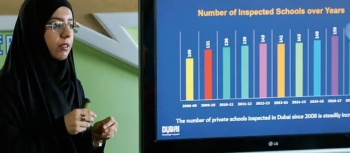
This week the Dubai School Inspection Bureau (DSIB) published its 2010-2011 report on private schools in Dubai. It did so along with the startling statistic that the annual turnover of staff in some of these schools is 60 per cent, a “churn rate” sufficiently high as to hamper education reform, the bureau says. The vast majority of departing educators – leaving the country or school hopping, depending on the conditions of their entry to the UAE – were international teachers.
It might be easy to suggest that international teachers’ arrival always serves as a prelude to their inevitable departure. But the truth is, it is not only international teachers leaving schools in UAE, it is nationals, too, as both face the sometimes intense and different pressures of working in a system in flux. So why are they leaving? And what can be done to make them stay?
Sheikha al Muhairi has taught in a government school in Abu Dhabi for 14 years. She admits: “The pressure inside schools with all the changes, the lack of appreciation and the financial demands of life outside is pushing people out.
“I was going to resign, but personally I can’t imagine myself in another kind of job. This is a sacred job in religion and in culture.”
Set in a global context, teachers giving voice to grievances over pay and conditions is hardly new. In fact, it’s so commonplace it’s practically a permanent fixture on political agendas across North America and Europe.
But that simply is not the case in the UAE. Here it is an unforeseen consequence of a drive to increase the quality of government-funded schools and fix the curriculum and goals of private ones.
The drive to improve is necessary and laudable. The Department of Education and Knowledge (ADEK) recently revealed that 95 per cent of public school graduates are so ill-prepared for further education that they need to enrol in remedial courses for up to two years, primarily to improve English-language and IT skills.
Adec aims to eliminate the need for such programmes by 2017. In the classrooms of New Model schools – rolled out at the beginning of the 2010-2011 school year – mathematics and science are taught in English. The pupils are expected to be bilingual, which means, increasingly, that teachers are, too. At the same time, many nationals are finding that the teaching methods they have relied upon for years have suddenly fallen from favour. Held up to international scrutiny, they have been found wanting in the face of contemporary theory that promotes student participation and active learning.
Fatma al Marri, an FNC member and chief executive officer of Dubai’s education ministry, the Knowledge and Human Development Authority, admits: “In the past there has been too much rote-learning and standards have not always been high enough, so we do need to change. Right now so much [that is] good is happening.
“But the truth is we are losing good teachers. The school is not only the building. It’s not only the administration. The focus of the school is students, but if we are to provide the best for the students then first we must talk about the teachers.”
Figures issued by the KHDA for 2009/2010 showed that 1,787 of the 3,154 teachers working in the state system were Emirati. This broke down to 123 men and 1,664 women. But the most recent figures, seen by The National, show a drop of more than 500. Today, 1,237 Emirati women are teaching in Dubai’s public schools and only 33 male nationals.
In Abu Dhabi, 4,319 of the 10,854 teachers employed by ADEC are Emirati nationals. Little wonder if some local teachers feel eclipsed by their international counterparts.
Ms al Marri suggests increasing pay as a good start in the bid to improve teacher morale. She is not alone in voicing this apparently simple fix.
Toni Breigel, an associate professor at Zayed University‘s College of Education, says: “Many of our best teacher candidates are leaving education and going into other government sectors or business because of the money. One of our very best graduates, a born teacher, took an entry-level job at another government institution making more money than educators with 30 years’ experience and PhDs make.”
But keeping teachers is a delicate art and one that involves more than a simple pay hike, however welcome that may be. After all, expatriate teachers are being lured with the promise of “lucrative tax-free salaries”, accommodation, furniture allowances and other bonuses and, as this week’s figures show, they are still leaving in droves.
David Allison is managing director of Specialist Schools and Academies Trust (SSAT) in Abu Dhabi. He has more than 20 years’ experience as both a teacher and teaching consultant in the Middle East. His company provides teachers for several private schools in Abu Dhabi as well as working with 21 schools under ADEC’s Private Public Partnership (PPP) programme. Piloted in 2006 it places international teachers in classrooms alongside local teachers.
According to Mr Allison, the key to finding a way through these times of upheaval is to establish a clear understanding of the roles of both local and international professionals and defining how they relate to the students and to each other.
He explains: “With expats in local schools it must be clear that they are there to advise, support and mentor. They have to learn as much as they give. Yes, they have certain skills, but they don’t know all the answers.”
Lowola al Marzouqui, a former teaching student turned faculty member of Zayed University in Abu Dhabi, echoes Mr Allison’s view. She says: “Parents read about all these expatriate teachers and assume that they are the only qualified teachers. That assumption is wrong. Emirati teachers are not promoted in the right way. There are Emirati teachers who are qualified at contributing to a good school system, and to be an Emirati in a classroom is to be a role model and to be proud of your children and culture. It’s truly an important job.”
Ms Breigel agrees: “While western teachers are certainly helpful, they should absolutely not be seen as in any way replacing national teachers.”
Shaun Robison, 29, is an education consultant and teacher who has worked in Al Ain and Abu Dhabi since 2008 in both public and private schools. He acknowledges the potential for unhappiness in both local and expatriate teaching communities: “Essentially, you’re asking people who have taught for perhaps 20 or 30 years to change the way they do everything.
“Initially there was some resistance. But I’ve been here for three years now and that’s changed. I think that once everybody knows what they’re working towards and why things are changing, that helps enormously.
“For example, some local teachers were initially worried about the changes in the way their performance was being evaluated. The previous system wasn’t rigorous or based on specific criteria and meant they were simply awarded a mark at the end of the year and that was that.”
But the new system, which he described as developmental, is “ongoing and that means a shift in the way you approach teaching and your own career development”.
There is a degree of turnover built into any system that includes expatriate workers. But, of the 160 or so staff employed by Mr Allison teaching at schools in Al Ain and Abu Dhabi, the average annual turnover is, he claims, just five per cent to six per cent. The majority of teachers stay three to four years, however.
Having worked throughout the Middle East, Mr Allison estimates that the average annual departure in Middle East schools is 20 per cent and anything up to that rate could be regarded as normal and no cause for concern.
International teachers leave for a variety of reasons: a desire to see other countries, family commitments back home, the discovery that life in the UAE just isn’t for them or that teaching overseas isn’t what they hoped it would be.
Mr Allison admits: “The fact that there is so much reform means that it isn’t a time for the fainthearted. The lack of stability is difficult for some.
“Any education reform is painful at some point. When the national curriculum was brought into the UK in 1988 there was an outcry, but it led to a far more rigorous, far more organised, far better education system and I don’t think anyone would seriously suggest going back to the previous way now.”
The same may prove true in the UAE. And while teachers – both international and local, working in private and public schools – may leave for a variety of reasons the view shared by all of the educators we spoke to is that, for the most part, they stay for just one.
They stay if they feel they are valued – a value that isn’t measured only in salary but in training, promotion and professional support.
All of this country’s considerable ambitions hang on the success of its education reforms. And if the modernisation and globalisation of that education system is to be achieved, then it’s not only students who need nurturing – it’s those who teach them, too.
© The National

















 Twitter