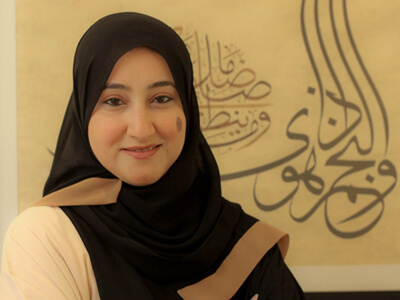
1. Tell us a little about yourself/ your job? Perhaps something not many people know?
I was born a few years before the UAE was formed. At the time, Kuwait used to build our schools, provide teachers and books, and so I grew up at a special time in the history of the UAE. I was also fortunate to be brought up around my maternal grandfather’s library – the biggest at the time. In his library I found some interesting books which whet my appetite for fantasy & Science fiction (SFF). In 1977, I saw the trailer of Star Wars, and got hooked on SF for the rest of my life.
2. Which books have most influenced your life?
I cannot name certain books, but most of the influence came from English SFF books. Every book which provided perspective and injected empathy into my life is a book I cherish and can never get enough of. In fact, because of these books, I was able to write my two novels, because they provided the formula and structure to build on, having read very few Arabic novels and knowing next to nothing about how Arabic literature is written.
3. What/ Whoinspired you to write QuttaQutna, Kunfuth Kiwi, أجوان (Ajwan), &ماندان (Mandaan)?
In the case of children’s books, I am only compelled to write out of personal experiences. For QuttaQutna (Cotton the Kitten), I was influenced by finally owning a cat and discovering the special relationship humans can have with their cats. For Qunfuth Kiwi (Kiwi the Hedgehog), my kids found a hedgehog in our garden, and she gave birth to 5 babies in the first 48 hours of finding it. I was fascinated by this and simply had to write about it. The two animal books contrasted caring for domestic animals, and what to do with a wild animal.
As for “Ajwan” and its sequel “Mandan”, that was a different ballgame. In my need to provide Arabic content for my teenage children, I chose SF as a genre which I hoped would compel Arab kids to fall in love with Arabic. Faced with so many topics to write about, I chose to write about a girl who becomes a refugee from the very first page of the book. In the Arab world, there are more than 15 million refugees and their stories need to be told. However, I also decided that she had to snatch herself out of that situation and take charge of her life. I also chose for the antagonist to be a man with a personal agenda who recruited his army from the disenfranchised and marginalized youth, making them steal, kill and blow themselves up for what they perceived to be a just cause. When I explain this to Arabs who have not read my novels, their immediate response is that this can’t be science fiction, as it is in fact the status quo in the region. Which is exactly the purpose of SF, in my opinion.
4. Which was your favorite chapter (or part)to write about and why?
I loved writing action scenes – although they were the most difficult – because that is what I loved reading as a teen. I enjoyed the sub-plots and the diagrams and sketched maps I had to make on post-its and scraps of paper as I plotted who did what to whom, where, how and why. This involved a lot of reasoning, which is my favorite part of writing, because when doing that you stretch the mental muscles of young readers and make them demand plausibility.
5. How would you describe your writing style like and how long did it take you to complete?
Ajwan was done by April 2011, and Mandan was done by Sep 2013. Both were written in a period of 9 months. This was accomplished by assigning a daily number of words, and by trying very hard not to incur the wrath of my friends whose job it was to ask me every day: have you written 800 words today? So I endeavored to write whenever I had free time, sometimes even at the hair salon as I did hair treatments etc. We waste a lot of time and we don’t know it. Writing the books showed me how much time I wasted every day.
6. What do you think about the ebook revolution?
E-books serve a purpose in a highly mobile world. I love my paper books, but when I am stuck somewhere without notice, I don’t have my printed books with me. This is when the kindle app on my iPhone comes in handy. A lot of books are not available in our shops, and the time and cost of shipping them is sometimes prohibitive, this is when E-books are a blessing. Each format has its audience, and I don’t think either will cancel out the other – not for a very long time.
7. If you could write about any personality (fiction/nonfiction) who would you write about?
I’d love to write about historical Arab men and women and put them in fantasy settings. I am actually working on such a project right now.
8. How do you develop your plots and characters?
First comes the idea, which has to be written down in a paragraph or so. Then I decide which are the main characters, and I write their history (their family history, what do they love/hate, their fears, ambitions). I have to understand the characters so that later when I am writing them, their actions and dialogue stay in character. The plot consists of main ideas, broken down into chapters, and then chapters are broken down into scenes.
You’re by now impressed at how that sounds really organized and obvious. Well, most of the time I write scenes as they come to me and then fit them into the plot. So, it’s quite chaotic throughout, but it is the last stage of writing, when I arrange everything chronologically, that one could call organized and sensible. Kind of like an upside-down cake.
9. If you could spend time with a character from your book whom would it be? And what would you do during a day?
I think I’d like to spend time with Major Rohani, who took Ajwan under her wing and cared for her at a most vulnerable time. We’d have coffee and discuss politics, and I would ask her advice on how she so efficiently runs a military space station.
10. Are your characters based off real people or did they all come entirely from your imagination?
Ajwan isn’t based on a particular person, but she does represent refugees and their plight. In her life before the disaster that took away her planet and family, she represents Arab girls who live in traditional families, and hunger for a different life.
The antagonist, At-Tareq is based on criminal masterminds who feel entitled to glory, and who use others to further their personal agenda. At-Tareq is every terrorist leader in our modern history. The rest of the characters were born out of a need for certain elements in the story: the mentor, the colleague and all the people who played a part in the plot. Some of their attributes were taken from people I personally know, but only some.
11. Tell us a little about your plans for the future. Are you working on another book?
Ajwan is supposed to be a tetralogy, so I am writing book 3 right now, and already have some scenes from book 4. Also in the pipeline, is a YA fantasy novel set in the UAE, and another novel of a historic figure in a fantasy setting.
Meanwhile, I have launched my publishing business, Makhtoota 5229 which will focus on the rarer genres in the Arab world like SFF, horror, supernatural and whatever Arab youth are hungry for.
About the Author
Born in Sharjah, cultural capital of the UAE, Noura Al Noman became a writer at 45 years of age. In 2010, she published two picture books for toddlers: “Cotton the Kitten” and “Kiwi the Hedgehog”. Noting the huge deficit in books for young Arabs, she wrote “Ajwan”, one of a handful of science fiction novels in the Arab world. Noura believes that Arab youth are hungry for fiction, and hopes science fiction will provide compelling Arabic content. “Ajwan” won the Etisalat Best YA Novel Award in 2013. Book two, “Mandaan” was launched at the Cairo Book Fair, January 2014, and she is working on the third book in the series.








 Twitter