Beirut, Lebanon: Experts believe the French language is not at risk in Lebanon despite a clear increase of schools that use English as a language of instruction, saying that two-thirds of the country’s students can still be classified as French-educated.
“There is definitely a dominance; a majority of schools in the private and public sector are using French as the first foreign language,” said Fadi Yarak, the director general of education at the Lebanese Education Ministry.
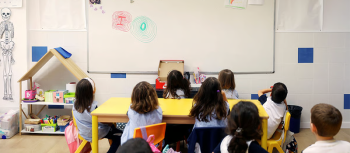
Lebanon’s educational system is structurally bilingual and children study some six hours of a foreign language – French or English – per week, beginning in preschool, in addition to later taking scientific subjects in the same second language.
When Lebanon gained its independence from France a large majority of schools used French as the second teaching language, but some schools slowly started switching to English, a phenomenon that gained momentum in recent decades.
But to Christophe Chaillot, who is in charge of linguistic cooperation at the French Embassy, “the share of English is increasing [in Lebanon], like everywhere else in the world, but this doesn’t happen to the detriment of French.”
He dismissed the idea of a disappearing, “ageing francophone”due to English and noted that out of 900,000 students from pre- to high school, 600,000 were registered in “French-medium” schools, or schools relying on French as their principal foreign language, compared to 300,000 in English-medium schools. In addition he said, some 50,000 attend one of the 35 French lycées of the country and follow the official French curriculum.
Bouchra Adra, a consultant in educative, linguistic and cultural cooperation, was less optimistic and stressed the percentage of English-medium schools had increased more than 3 percent since 2003.
“We fear that if we don’t make very important efforts to promote the French language and encourage Lebanese students [to follow French-medium education], we run the risk of losing even more of them,” she said, pressing for “actions and precautions” to be taken.
“We need to find efficient and motivating ways to attract the young people, who now tend to think that English is easier and more useful,” she added.
A “francophone” culture is still extremely active in the country. In March, various cultural events took place across the country to celebrate the francophone month, with many other activities organized throughout the year.
Last October, Lebanon became the first member of the International Organization of Francophonie to sign a linguistic pact aiming at reinforcing French in education, public administration and cultural, economic and media fields. Some of the projects include installing trilingual signs in public places such as airports, training courses for taxi drivers and public administration staff.
Chaillot explained that on the education front, the embassy was working with its national partners on improving the methodology and pedagogy of French instruction and focusing on “French outside school,” by organizing events concerning French language and culture.
A program introduced three years ago, in collaboration with the Education Ministry and the Center for Educational Research and Development, also aims at bringing teachers’ French standards in line with European standards, and 500 teachers have already received official certificates.
But to Adra, students’ French-language abilities are still simply too weak. She pointed out that between 2004 and 2009, only 35 percent of all French-educated students passed their French test at the “brevet,” an examination taken by 15-year-olds.
She said there was a real gap between the level of prestigious establishments, “where students are completely bilingual and sometimes even trilingual, and the majority of students whose weak level is becoming more worrying every day,” although noting this issue also affected English-medium schools.
“There is a whole linguistic policy to reform … we need to reconsider the language instruction methodology,” she said. “It’s never too late, and all actors should work toward improving the instruction and use of French in Lebanon, which is a stronghold of francophone in the region,” she added.
Yarak acknowledged there were “challenges.” “But our vision is clear and hopefully we will reduce the gaps in languages,” he said.
“It’s a plan, a process but we’re committed to it,” he added, saying the ministry was working “in full cooperation” with the French Embassy.
“We’re a francophone country, and we’re proud [of it],” he added.
To Chaillot, “French, for historical reasons, is part of the Lebanese cultural identity. “We’re not in a situation of linguistic war because of the past, we’re more in a situation of joint history and friendship and language is one of its vectors.”
To Mouzayan Darwish, director of Beirut’s Ecole Normale, which provides training for school teachers, French-speaking is not in danger in Lebanon as “it’s part of us, of our habits, of our past and of our future.”
She argued there were “affective and social ties [with French], while English is more a language that offers work opportunities.”
Yarak also suggested work opportunities might be a reason for the increasing demand of English-medium schools and added that entrance exams in the country’s English universities were known to be easier and their success rate higher. At present, some 50 percent of students follow a French-medium university curriculum.
Chaillot said he believed the increasing percentage of English-medium schools should be linked to the Lebanese “culture of plurilingualism,” “symbolized by the ‘Hi Kifak ça va’” phenomenon. “It’s not a coincidence if multilingualism is present in the Lebanese greeting formula; it’s part of Lebanese identity.”
Noting that in 2010, 10,000 non-French-educated students registered in French courses in the country’s nine cultural centers, he argued that “people want to be trilingual in Lebanon.”
“These are people who … consider [French] part of Lebanese culture and plural identity,” he said, insisting Lebanon has a “real trilingual vision.”
A decree implemented tri-lingualism in the education system in 1996 by making it mandatory for students to start learning a second language from the EB7 level (12-years-old).
Chaillot also noted that “mastering three languages doesn’t mean having native speaker’s capacities in all three.” “When we promote French, we don’t play on the backward vision of French being an elitist language” that should be spoken perfectly, he said.
“We’re convinced that multilingualism is the future and that French has a place in it, not in opposition to other languages; that would be ridiculous,” he concluded.
© The Daily Star














 Twitter