


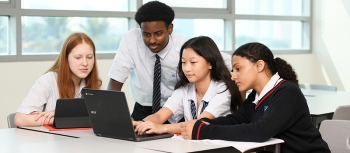
A flipped classroom is where children are at the centre of learning rather than the teacher. This concept is being hailed as ‘innovative’ by some educationalists who believe that learning primarily still revolves around the teacher conveying information, assigning work, and leaving it to the students to master the material.
In order to achieve the concept of flipped classrooms, leaders must be dedicated to ensuring teachers are trained in methods other than using a textbook or creating a worksheet. Our vision of ‘learning to learn, be responsible and to lead’ embodies our belief that for the best learning to take place, children need to be true participants in their own personal learning process. At Nibras International School, which serves children aged 3-18 years, we are committed to the concept of flipped classrooms.
We believe that with our access to high-level brain research and learning theory there is no excuse for a teacher to still force students to merely be ‘receptors of information.’ We know for a fact that children (and adults) learn best under specific conditions and we remind ourselves of these conditions constantly.
In our classrooms, we aim to transform learning and ensure that:
We see this as crucial for the whole learning process to work. It’s not just a feel-good factor. The role of curiosity in effective learning has often been studied (although perhaps not enough) and we as teachers are aware that without natural curiosity the prospect of a child meaningfully interacting with others, the world, texts, and so on, are limited.
We train our teachers to ‘flip’ the ratio of teacher talk to student talk 20:80, in order to promote dialogue and questioning which in turn develops curiosity. This means our teachers will try to talk around 20% of the time and enable children to talk 80% of the time. We believe it makes sense for good questions to lead the learning, so we place a high value on these questions and students asking them. Rewarding questions rather than answers is a great ‘flip’ which brings significant change.
When teachers and children come across sources which disagree then they enjoy that moment because they know that is what the world is like, full of contradictions. Using divergent sources shifts credibility.
This includes inquiry-based learning, projects, teacher directed learning, peer learning, eLearning, Mobile learning, and so on – at Nibras the possibilities are endless. We feel that no one model is amazing enough to match the learner diversity in our classrooms. Whilst it is always a challenge to meet every learner’s needs the spin-off is that our teachers will become highly skilled practitioners and lifelong educators.
Our vision revolves around our students and teachers connecting learning to prior learning and ensuring that everything we teach begins and ends with real life. Our teachers will plan for connections and often arrange for students to leave the classrooms for field trips in the school grounds and further afield to support connectedness with the world beyond.
No longer do we believe that the personalisation is purely the domain of the teacher. Rather we plan on criteria, language skills, interests, gender, reading ability, readiness for content, stage of development, again, the list is endless. We then adjust the pace and entry points according to each child’s own learning journey, so we support what they individually need.
Our commitment to ongoing, transparent, persistent and authentic assessment which is never punitive, supports our belief in ‘flipped’ classrooms. We constantly ask ourselves why we are assessing students and challenge the possibility that assessment provides little in terms of benefit to the child unless it has feedback at its centre. Our students will begin to understand through careful personalised feedback what their strengths and areas for development are and how to reach the next step to improvement.
Our students will not need to guess what success looks like. They will understand what a cohesive assessment process means to them and they will see feedback and assessment as an entitlement just as our teachers will see professional feedback as an entitlement.
With high professional standards and a commitment to high-quality professional development, our teachers will ensure that the best learning behaviours are constantly modelled by the adults in our school. As a teaching and learning team, we will demonstrate curiosity, flexibility, resilience, persistence, creativity, collaboration, reflection and great listening. We are all aware that children pick up the subliminal messages which they see, much faster than the direct ones that they hear – display a bad habit for a while and see what happens! Children are great mimics.
The essence of our pedagogy, is of course, Bloom’s Taxonomy through which we revisit ideas and practices, review and reflect and re-evaluate. We try to approach challenges from different angles, moving from the simple to the complex so that we all maximise our opportunities to learn and demonstrate an understanding of the content. In short, we aim to provide endless opportunities for children and teachers to practice their learning skills.
In conclusion, we are determined to ensure that our classrooms are well and truly ‘flipped’ and as such we are devoted to expanding on and mastering a range of material through collaborative learning exercises, projects, and discussions and are therefore already ‘flipped.’ Our students will have control over their learning and they will learn at their own pace through a range of approaches which place learning theory at the heart of practice.
Any further ‘flipping’ in our school will also involve the planned development of technology as a tool for learning accessible to every child at any time through the ‘bring your own device’ scheme and the use of I-pads in early years. By ‘flipping’ our perceptions of how children learn best we are able to allow children more time to be children, ensure they engage positively in learning and make excellent progress. We think our way of ‘flipping’ is good and the only way to prepare our students for a real future through real learning.

Christine Simmonds is the Director of Schools ISP Middle East. Christine has extensive experience on educational structures, standards and processes in the Gulf and knows the education landscape in the region extremely well. After many years leading UK state and international schools, university departments, local authorities and government entities.
Christine became a founder member of the Dubai Schools Inspection Bureau in 2008. For the next five years, she was a key member of the Knowledge and Human Development Authority team leading the development of quality and research in public and private schools across Dubai.
She is passionate about ‘authentic’ education whereby children gain knowledge, understanding and most importantly the skills they need to be successful in today’s ever-changing world. She is dedicated to equity and high standards in teaching, learning and leadership and feels that her educational philosophy of placing the child central to school improvement fits well with that of her colleagues at ISP.
Christine has a Masters degree from the University of London, Institute of Education and most recently was CEO of Eton House School in Bundang, South Korea.



 Twitter
Add a Comment
Please do not post:
Thank you once again for doing your part to keep Edarabia the most trusted education source.