Riada American School, a leading institution of education, opened on its present site, a distinctive, architect-designed group of buildings, in 2005. Located in a central, peaceful part of Alexandria, the school provides a safe and environment for nearly five hundred students every year. In architecture and design, the School is modern and purpose built. RAS offers the American curriculum for grades K-12.
RAS is accredited by the Egyptian Ministry of Education as a co-educational, university/college preparatory school, which adheres to the American curriculum and grants the American High School Diploma. Additionally, RAS is also accredited by AdvancED.
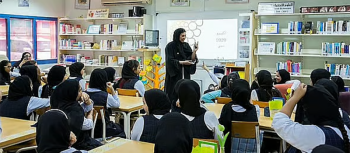
RAS firmly believes that small class size is highly conductive to learning. Small class size allows the teacher the opportunity to address individual academic needs, and to tailor teaching to each individual student's learning style. RAS believes in self-renewal and searching out best practices so that our students may participate in a rich, educational experience. Our students, in turn, are active, intelligent and creative learners. These positive attitudes unite us across all levels at RAS.
The core curriculum of RAS ensures that all students, receive a strong grounding in the traditional liberal arts and sciences. It aims to develop students basic academic and intellectual skills while enhancing their reading and writing skills, as well as their ability to reason and construct logical arguments. It strives to help students understand themselves, their culture, society and place in the world. It introduces them to the ways in which the sciences and humanities seek to comprehend and shape the world around us. The core curriculum lies at the heart of RAS’s commitment and is, first and foremost, an education in the fundamentals of learning itself.
Personal and societal decisions in the 21st century increasingly require scientific and technological understanding. Whether about health, the environment, or technology, a certain level of scientific knowledge is vital to informed decision making.
Thus, another goal of STEM education is to increase STEM literacy—defined as the knowledge and understanding of scientific and mathematical concepts and processes required for personal decision making, participation in civic and cultural affairs, and economic productivity for all students.
Targeting all students, not just those who will pursue post secondary education or careers in STEM or STEM-related fields, will better prepare citizens to face the challenges of a science- and technology-driven society.
Our parents are our partners in the education of their children. Parents volunteer in classrooms, are active in the Parent Teacher Organization, and lend their voices to our students’ education.
Please do not post:
Thank you once again for doing your part to keep Edarabia the most trusted education source.




 Twitter
there is a huge drop in the administration...what a loss!
By shakshouka (Mar, 2019) |