Little Oaks Montessori Kindergarten follows and upholds the values common to Montessori schools around the world. With international standard teacher training, quality equipment and a nurturing environment, we adhere exclusively to the Montessori philosophy of child education.
In a Montessori environment, the child is in control of his or her activity. Children can choose whom they’d like to interact with, and when they wish to do each activity (the latter with some direction to enable group activities). Each child is provided with opportunities to explore and the freedom to make individual choices on a daily basis, thus building confidence and independence.
The Directress and assistant staff facilitate rather than teach. The Little Oaks environment presents a wide variety of opportunities to learn, with each child deciding what he or she is interested in and the Directress encouraging and directing the child through the learning process.
The Montessori Method of Education is the basis of our curriculum and was founded by Dr. Maria Montessori. She believed that the child’s most crucial development stage is in the first 6 years of his/her life. During this period, the child has "An Absorbent Mind", taking in like a sponge the things that surrounds the child .
Dr Maria Montessori believed that a child’s ability to learn is a natural process, and each child should learn by “doing” and not simply by "listening". Her philosophy stands out from those of other Early Childhood teaching theories in her belief in the Environment as the teacher.
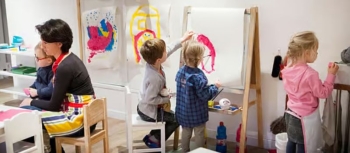
A Montessori classroom is a specially designed "prepared environment" in which the concept of "learning by doing” is manifest. It is a child-sized world in which everything is laid out in the most aesthetic and accessible way. This is to encourage the mental, physical and social development of a child. It aims to be a space devoid of irrelevance and inflexibility but in its calm and orderly presentation.
All of the materials for each area are arranged invitingly on low, open shelves. The children have access to the materials. They may choose what they like throughout the entire open-work time. When they are finished with the materials, they return it to the shelf from which it came.
The materials themselves invite activity. There are bright arrays of solid geometric forms; knobbed puzzle, maps, metal insets and various specialized rods and blocks. Each material in a Montessori classroom isolates one quality. In this way, the concept that the child is to discover is isolated.
The Montessori curriculum is non-graded and non-competitive, thus allowing the children to work and grow in an environment that permits their individual potential to reach its own level and at its own pace, without any negative or judgmental pressure.
The Montessori-Language Curriculum is quite different from a traditional preschool curriculum. Here the child learns the sounds of letters in a systematic, progressive way and then blend the letters to form a word. Every word is identifiable with an object so the child can feel, understand and match the abstract word to a concrete object.
The Montessori-Language program is graded by color coding. Each level / color builds on the previous one to provide a wide range of vocabulary. Sentence building with picture cards are also used besides reading books.
The Montessori Practical Life is the first in the series of Montessori education in Montessori schools. The child learns skills for daily practical living. Such preschool activities provide the foundation for coordination of movement, independence and a sense of order, concentration, and a care for himself/herself and the environment.
The process of learning the Montessori Practical Life skills is divided into clear isolated progressive steps. Without much verbal explanations, the child observes the well-defined and calculated movements and catches on with accurate imitation.The Montessori-sensorial curriculum uses specially designed Montessori materials to refine their senses of seeing, hearing, touching & smelling.
Sensorial exercises develop skills in thinking, judging, concentrating, comparing and sequencing. As the child works with the Montessori materials, they also develop new vocabulary relating to the activities and experience. The child learns to separate and classify forms, colours, textures, tastes and smells. This helps the child with skills needed later for reading, writing and Mathematics.
The cultural education is to help the child develop his/her own personality, adapt to his/her own culture, and become an independent, useful member of his/her society.
Montessori cultural materials provide individual activities, which helps the child to acquire knowledge in the areas of cultural awareness and appreciation, biology (botany and zoology), geography, history and science.
Please do not post:
Thank you once again for doing your part to keep Edarabia the most trusted education source.









 Twitter
My twin sons go here for their kindergarten. Innovative methods of teaching, artistic, kind Teachers, loads of group events and parents kids Teachers meetings are quite regular. All in all a superb montessori.
By Harsha K (Sep, 2019) |