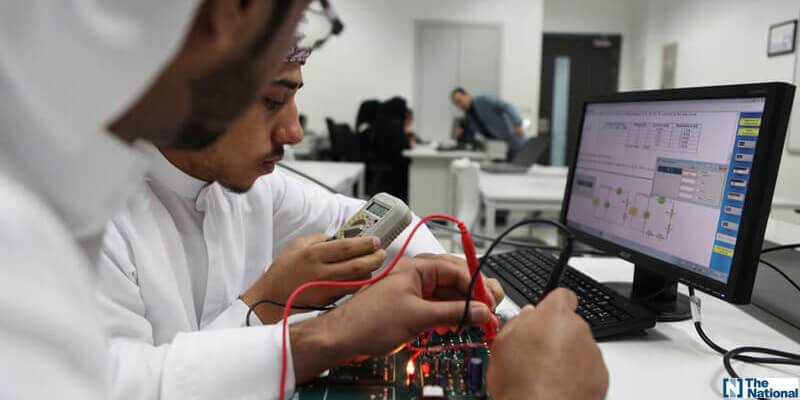
Special needs pupils need to be equipped with vital life skills to ensure they are not left ‘sitting at home’ after leaving school, education experts said.
Parents and teachers also called for more vocational education courses across the board to cater for those who don’t want to pursue an academic path.
They pointed to countries where technical colleges offer qualifications in technician and electrical work plus cooking, hospitality and administration, among other fields.
April McCabe, who has a 15-year-old child with autism, said more vocational courses would particularly help provide more opportunities in the workplace for young people with special needs.
“I think there is a need for more vocational pathways, that is one thing that is lacking here. For children with special needs, they finish school at 18 and then there is nothing,” she said at an education event in Dubai last week.
“These children just sit at home. They don’t have any job skills and they don’t have anything to look forward to and their behaviour escalates.”
A 2014 Deloitte study found that only one to 3 per cent of academic enrolment in the UAE is in vocational education, while the global average is 10 per cent.
In Germany, about 50 per cent of children leaving school take up vocational training, instead of university-based learning.
Nan Billingham, principal at School of Research Science in Dubai, said there is an academic-centric culture in the UAE and said vocational courses must be more widely recognised.
“Culturally in the UAE there is an expectation that 100 per cent of pupils to go to university or higher education,” she said.
“That’s not the case in UK or other countries where maybe 60 per cent of people go to university and others may have an alternative path.”
Her school offers BTECs in engineering and business.
“It would be great if here in the UAE the authorities would acknowledge the BTEC and ASDAN courses. I know they are looking at it.
“These are not recognised by local authorities. I know some universities will consider these but not the local universities.”
At present, the only such colleges are government-run and cater for Emiratis looking to study technical courses, such as Abu Dhabi Polytechnic.
Louise Dawson, head of inclusion at Kings’ School Al Barsha, said the school is starting a BTEC (Business and Technology Education Council) programme in September, which offers school leaver qualifications.
“We [in Dubai] don’t offer enough pathways and vocational is the big next step,” she said.
“Parents here want their children to be academically successful. They want them to have qualifications in English, mathematics, science, history, geography.
“In the UK our vocational courses would be in subjects such as bricklaying, tourism and hairdressing but families here don’t always want that for their children.
“We have just introduced additional curriculum pathways. Traditionally we are a GCSE and A-level school but we are now bringing in ASDAN and have a BTEC programme.
ASDAN programmes are qualifications that help pupils learn skills through personalised education.
“We need more curriculum pathways in Dubai. It’s difficult because they aren’t always recognised here.”
The teacher believes that pupils buy into vocational education as it teaches them real-life transferrable skills.
In 2017, The National reported a surge in Emiratis enroling in more vocational courses, with pupils taking up courses in business, aviation maintenance, health sciences and media production.
© The National









 Twitter