


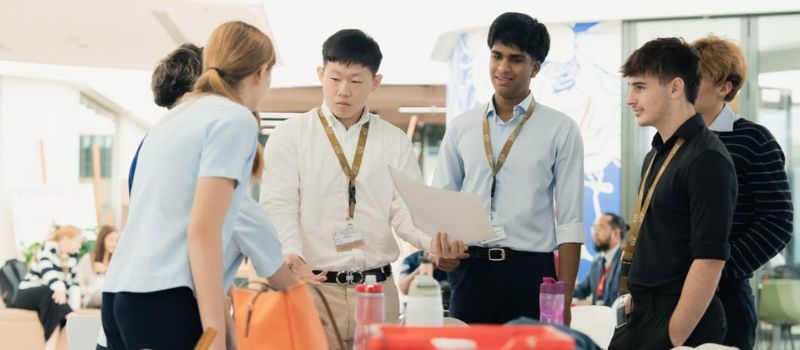
A student at the Jumeirah English Speaking School, Francesca believes it is vital for teenagers today to be careful when sharing personal information on the internet. Having moved to Dubai in 2018, she has seen many parts of the world and has interacted with different personalities. Our exclusive interview with Francesca highlights the importance of being safe online.
Why is it vital for teenagers of today to be more aware of the personal information they divulge online?
As the internet becomes an increasingly essential tool in 21st century communication, I think we have to be mindful of what we put online. Teenagers today have had access to technology since our early teen years: I got my first smartphone at thirteen. Teen years are a wild ride. Since our personalities form in this period, “new year, new me” takes on a literal meaning. Posts that I made only three years ago do not reflect who I am now, and what I’m writing now (in this interview!) may not reflect my viewpoints in five years. This permanent aspect of the internet should be taken into consideration when publishing any kind of information online.
Being aware of what you’ve published online can help prevent the embarrassment of new friends scrolling to bottom of your social media profile and finding relics of your 13-year-old self. Furthermore, as individuals who will soon be searching for employment, teenagers of today must be aware that their future employer will almost certainly run an online background check on them. Knowing exactly what’s out there about myself has brought me immense peace of mind.
Having moved to Dubai in 2018, is there a big trend of teenagers handing out personal information online with ease? Are teenagers more, or less careful in the countries you’ve lived in prior to the UAE?
I think it’s important to reflect on what is exactly meant by “personal information”. When my parents got me Minecraft (online, multi-player game) back in 2013, they told me not to share any private information (full name, city of residence, etc.) with strangers I met online. I don’t think teenagers actively hand out their personal information online, but rather they do so in indirect ways. The way we share information on the web has changed since the “stranger danger” days. With the rise of social media, the internet has become a place to discuss and share information. I think this way of communicating has become universal and is the same whether you’re in Switzerland or in Dubai. Social media accounts usually have a surprising amount of personal information: everything from your passion for cute cats to your political stances is recorded. While each individual piece of information may not be personal in itself, the collection of that information is unique to you. As we’ve seen with the Cambridge Analytica scandal, this information can be used against us in ways we cannot fathom.
Series such as ‘The Maze Runner’ and ‘The Hunger Games’ were at their prime during the time of release. Do you think Dystopian novels like these were so popular among kids, teenagers and young adults for any particular reason?
I think the main allure around dystopia as a genre is that it shows how things in our current world could go wrong. While the likeable characters and exciting storylines definitely play into making dystopian novels successful, I think what differentiates dystopian novels from – for example – adventure novels is the cautionary message. Gattaca was a dystopian movie that took place in a world where genetic engineering on humans was possible. The mind-blowing thing is that, to an extent, science has already gotten to that point: right now, gene therapy has helped people with otherwise incurable diseases live a better life. While this movie was released over two decades ago, the dark side of genetic engineering in humans is central to the plot: what are the consequences of enabling the creation of a genetically superior human race? What happens to those who do not have the financial means to access this technology? In a certain way, this could be seen in the technological divide today: those who do not have access to the internet are cut off from a myriad of opportunities; on the flip side though, may that be better? There are probably a few dystopian novels that explore that idea.
As you can express yourself in three languages while taking on a fourth, what tips do you have for teenagers like yourself who are looking to learn a second language? What was the learning process like for you?
I think the best thing one can do, once the basics of a language have been assimilated, is to read books. Until last year, all my schooling had been in Italian, and I had only done very basic English classes as a kid (learning phonics, etc). While I spoke English at home, I really strengthened my skills by reading. In elementary school, I had a 3-hour gap between my choir and piano classes after school. To pass the time, I started bringing a few books with me. Soon, I dived into R. Riordan’s Percy Jackson & the Olympians series, and many other young adult novels. Many books later, I realized I had up-leveled my vocabulary and grammar from that of an 8-year-old through passive learning.
Thus, my tip is to find a book you would genuinely enjoy reading in the language you want to learn and let the learning come by itself.
Can you tell us more about your upcoming session at GESS titled “Online, But at What Cost”? What can visitors expect to learn from the session?
I hope to do what the dystopian genre does best: to trigger critical thinking on current world issues. As the title suggests, I’ll discuss how technology and the online world has an impact on our lives, and my ultimate aim is to make my audience reflect on their relationship with the online world. Are we living in a parallel universe’s dystopia?








 Twitter
Add a Comment
Please do not post:
Thank you once again for doing your part to keep Edarabia the most trusted education source.