
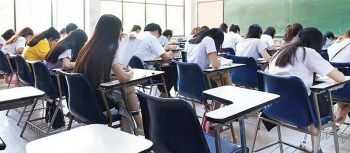
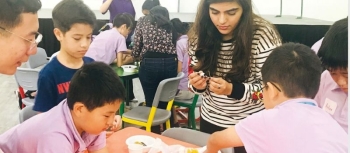
Loris Al Ghoul runs a classroom with 53 pupils and one working microscope. They line up to peer through its lens. When grading papers, pupils swap and mark each others.
This is not an exercise in learning but a necessity.
Ms Al Ghoul is a biology teacher at Sukaina bint Al Husain Secondary School in Amman, Jordan. Her work begins before dawn and often ends late at night.
“It’s a pressure,” said Ms Al Ghoul, a teacher of 21 years. “I have to let them grade their own homework. I just can’t do it.”
She is one of 1,350 teachers to receive teacher training and psychological support under a five year programme with Dubai Cares and Jordan’s Ministry of Education, in collaboration with Save the Children Jordan, Community Jameel and Massachusetts Institute of Technology (MIT).
Dubai Cares has invested in three educational initiatives launched this year, totalling more than Dh26 million.
When a delegation from Dubai visited for the September launch, teachers greeted them but no classes were in session that day. Amman’s teachers had just begun a month long strike over low pay and overcrowded classrooms that brought the city to a standstill.
The strike was resolved with teacher’s pay demands met. But the Jordanian school system is at a breaking point.
Jordan hosts the second highest number of refugees per capita in the world, including more than 1.3 million Syrians. Almost half of Jordan’s refugees are under age 15, including 125,000 born in Jordan. Most are settling in for the long term, with four out of five Syrian refugees integrated in urban communities.
This has led to severe overcrowding in city schools, double shifts for teachers, and pupils coping with trauma from conflict and displacement.
To ease the pressure, Dubai Cares has invested in early education, high school graduation and psychological support for teachers.
The first project is a Dh5.5 million commitment to give 1,620 principals, teachers and counsellors training in teaching and mental health, through an app developed by MIT’s Abdul Latif Jameel World Education Lab.
The initiative, which costs a total of Dh20.2 million, will help teachers on the frontline of education, said Tareq Al Gurg, chief executive of Dubai Cares.
“The first solution is training the teachers. If teachers are not happy in their life and their work, morale declines,” he said.
For teachers like Ms Al Ghoul, it is a significant step.
“You must take care of teachers because they take care of students,” she said.
Secondly, Dubai Cares has dedicated more than Dh5.8 million for a two year programme preparing 4,000 5 and 6 year old children for Grade 1. The investment includes refurbishment of kindergarden classes and the development of teaching app for parents and teachers by the UAE-based education tech companies.
Finally, Dubai Cares dedicated Dh14.7 million for an app that helps teenagers pass the high school final exams. The app is designed for teenagers who cannot, or do not, want to go attend school, due to financial pressure, bullying, transport costs and early marriage for girls.
Dubai Cares connected the creators of the Miyamiya app with Questscope, an NGO in Jordan that works with out-of-school youth.
The app will be (roll out over three years) with lessons adapted to the Jordanian national curriculum in Year 11 and 12 maths, physics and English.
“The main three reasons why people drop out, is the school itself,” said Ma’en Rayyan, a project manager at Questscope.
“It’s the curriculum, the teacher and the teaching methods. The main reason [people leave] is because they don’t want to go to school, not because they want to labour. It’s not an attractive or safe environment.”

Mother’s regret over refugee daughter married off at 14
Each of Samar Mamdoh’s four children faced a different set of challenges on the road to education.
The eldest, Khaled, left school when the Syrian war began in 2011. When the family moved from their farm to Al Kiswa city, Ms Mamdoh decided against enroling her children after two explosions hit the local school.
Khaled continued his education against her wishes.
“I was very worried but I couldn’t tell him no because it was his dream” says Ms Mamdoh.
On the day they moved to Jordan, Khaled discovered he has passed his year nine exams, a landmark in the Syrian education system.
In Jordan, he worked part time at an internet cafe and studied for the high school final exams. But on exam day, he was beaten by bullies and he has not returned to re-sit tests. He received a scholarship to study multimedia at a college but quit due to transportation costs.
Ms Mamdoh’s second son Hamza, 14, has a grade one education. He began work when the family arrived in Jordan at age 10 to support his family. He works as a baker.
“There were bills to pay,” says Ms Mamdoh.
“He doesn’t get enough money to help us much but he doesn’t take much from us.
He’s very young to be supporting himself, to buy himself pyjamas, trousers, shirts. He has needs and as parents, we can’t give him anything. I want my son to get an education, to get even the basics, I want him to make up what he missed.”
Ms Mamdoh’s daughter was married a few months after arriving in Jordan at age 14 to a man from Homs, who was 21. They live in Turkey and have two young daughters.
She hasn’t seen her daughter in person in five years. Marriage was the only way she saw a better life for her daughter, says Ms Mamdoh.
“Yes, it was wrong but it wasn’t intended. This was not the plan but the war changed the whole family’s destination by 180 degrees.”
Ms Mamdoh’s youngest child Ahmed, 7, joined a daycare renovated by the Dubai Cares and Plan International Jordan last year. He started grade one in September.
“The only hope I can see now is Ahmed,” says Ms Mamdoh.
“He’s in school now I hope he can do what his brothers couldn’t do.”
Ms Mamdoh’s hopes are pinned on immigration to Europe. Ahmed hopes to fulfil his brother Hamza’s dream and become a vet.
© The National











 Twitter