


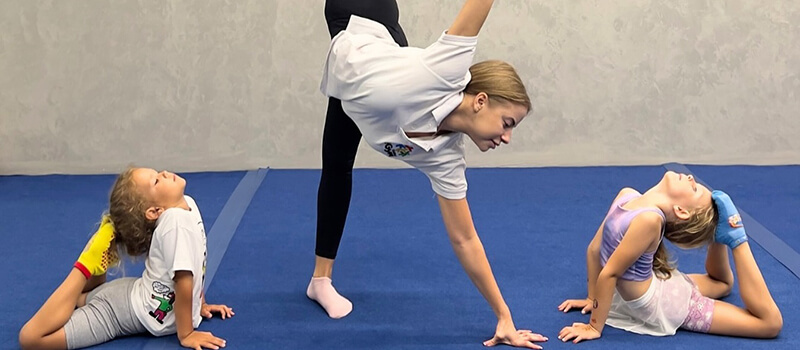
Gymnastics is often a preferred choice by parents for their kids as it helps in building the three essential components of fitness – strength, flexibility, and balance. However, science reveals that gymnastics is not just about the body, but it has a major impact on the brain as well. In fact, it is one of the key factors responsible for the cognitive development, improvement in academic performance, and overall learning process of children. As the scientific community delves deeper into the relationship between physical activity and brain function, it becomes clear that gymnastics is the best exercise to enhance memory, focus, emotional regulation, and long-term learning.
More and more educators and parents, locally and globally, are coming to the realization that the mind-body connection is much more complex than was believed before. These are some of the ways gymnastics helps children develop cognitive skills, become better learners, and eventually turn into more focused and motivated students.
According to cutting-edge neuroscience, one thing is very clear: a child’s cognitive growth cannot do without physical activity. Physical movement in children leads to increased production of oxygen, hormones, and neural connections in the brain, which are the major drivers of learning abilities.
In fact, gymnastics for kids is the one that achieves this goal very effectively since it involves various bodily systems simultaneously. For instance, the brain-body communication has to be very accurate to execute skills like balancing on a beam, coordinating handstands, or even memorizing routines. Hence, it helps in the formation/strengthening of neural pathways/links related to focusing, decision-making, and memory, and thus makes the cerebral cortex more capable of solving problems and storing information.
Various experiments indicate that kids who habitually partake in physical exercises have better academic performances than those who do not, and professionally organized sports such as gymnastics rank among the top stimulants of children’s brain power because they entail the most rigorous aspects of a player’s (or athlete’s) psychological and intellectual capacities, namely discipline, focus, and multi-step thinking.
Attention skills are the backbone of success at school, particularly in today’s world full of different types of distractions. Gymnastics, by its nature, equips children with the skill of concentrating better. Most probably, while carrying out a new-movement-learning or a cartwheel-attempt, a child has to dismiss all external noise and fully engage in the activity, anyhow. This skill of continuing one’s focus is then handed over to the school, where it helps pupils to focus more on their classes, be more attentive, and even complete their assignments without their minds wandering off.
Moreover, another point worth mentioning is that by engaging, the executive functioning component (the mental skills that primarily aid in checking one’s impulses, planning, and sticking to objectives) gets a workout too. The children who frequently do gymnastics usually show that they more easily change from one task to another, their self-control is better, and also they are capable of sustained mental effort to a much larger extent than their counterparts.
Gymnastics is a sport that puts a very heavy load on the memory of children. They have to understand the sequence of moves in a routine, listen attentively to what the coach is saying, and perform a seemingly complicated series of movements quickly and accurately again. This continuous learning and recalling exercise serves to enhance working memory, a skill that is very important for reading, math, and problem-solving.
When children are involved in gymnastics training, their brain become more efficient at organizing and storing information. This competence enables students to easily execute multi-step instructions, quickly grasp academic concepts, and get better at subjects that demand fast thinking and memory recall. The mental discipline that comes from the gym is transformed into a valuable academic advantage.
Cognitive development is not purely a matter of thought – it also means being able to handle one’s emotions, especially in situations such as exams or dealing with unfamiliar assignments. Gymnastics is a kind of experience that provides a solution to kids’ problems with pressure, frustration, and fear management.
Every gymnast probably remembers times when they were full of doubt and had been disappointed in new skill attempts, but along with that, they also learned how to stay calm, breathe deeply, and give it another go. This emotional resilience, in fact, has a very strong connection to improved cognitive performance. Kids who can control their feelings are better equipped to deal with stress, focus on the task at hand during difficult times, and use a calm approach to work out solutions.
Similarly, physical exercise acts as a stress mitigator because it lowers the level of stress hormones like cortisol and boosts the production of endorphins, which leads to a better overall state of mind and mental clarity. Great concentration, motivation at a higher level, and an optimistic attitude towards learning are just some of the effects of this for students.
Motivation is a very big factor that influences a child’s academic success and gymnastics by nature is one of the ways that amply provides it through a continuous cycle of effort and reward. It is every time, a skill is under the child’s control—be it the holding of a handstand for a few seconds longer or the sticking of a landing—that he/she experiences a feeling of accomplishment that in turn ignites the flame of the desire to improve even more.
This inflated self-image has a very direct effect on learning. Motivated kids will be more willing to work on challenging homework, experiment with new subjects, and put in the necessary effort to succeed. Through gymnastics, youngsters come to know that improvement is a result of practice and not of getting everything right at first time which helps them cultivate a growth mindset that will serve them well in their academic life.
Gymnastics calls for balance, awareness of space, and accurate coordination—capacities that are all closely related to brain development. According to research, children who are involved in activities that require and improve coordination skills are also more likely to have better reading comprehension, mathematical reasoning, and decision-making abilities.
While performing various exercises, kids’ brains are constantly figuring out the timing, the right position, and how to have control over the situation. Such multisensory learning, in this case, is strengthening the part of the brain that is responsible for not only motor control but also cognitive regulation–the cerebellum. A more powerful cerebellum translates into better information processing, quicker reaction times, and sharper thinking skills.
Gymnastics not only provides children with physical fitness.
It is a powerful tool for cognitive growth as it molds better learners, better thinkers, and more confident individuals. By means of better focus, stronger memory, emotional resilience, and enhanced motivation, gymnastics facilitates a clearer and more confident academic approach in children.
While the UAE is moving forward with its vision of holistic education and healthier lifestyles, gymnastics can be seen as an effective means of support for students both inside and outside the classroom. The sport, by bringing together movement, discipline, and mental challenge, not only helps kids to be ready for lifelong learning but also to have stronger and more resilient minds.














 Twitter
Add a Comment
Please do not post:
Thank you once again for doing your part to keep Edarabia the most trusted education source.