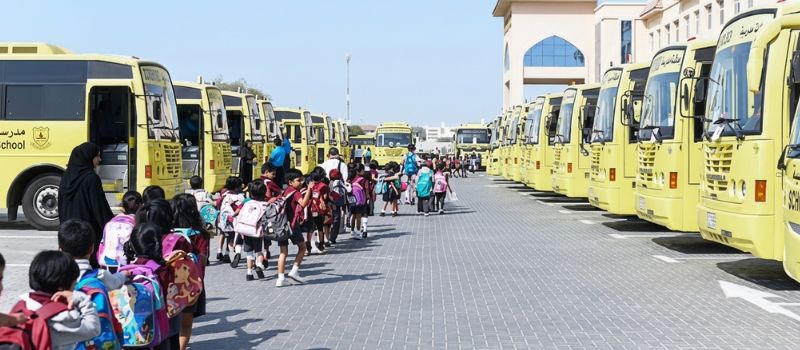
The Ministry of Education (MOE) had earlier approved a unified academic calendar for public and private schools across the country
The UAE has confirmed its school calendar for the coming academic years— but for many families, the question isn’t just about dates anymore.
It’s about how disruptions have already reshaped routines, and what that means going forward.
The Ministry of Education (MOE) had earlier approved a unified academic calendar for public and private schools across the country, outlining term dates through to the 2028–2029 academic year.
While the framework provides long-term stability, recent weeks have shown how quickly routines can still change.
Start of academic year: August 31, 2026
For the current academic cycle, schools will close on July 3, 2026 (July 2 in Sharjah), with a short break between May 25–31, before resuming on June 1 in alignment with Eid Al Adha.
While authorities have maintained the unified calendar, schools across the UAE have recently had to adapt quickly to changing circumstances due to the US-Israel-Iran conflict which has now entered an extended ceasefire —ranging from temporary shifts to distance learning to adjustments in assessments and daily schedules.
Educators, too, had to recalibrate — moving lessons online at short notice and ensuring students stayed on track academically.
Indian curriculum schools, including those following CBSE and CISCE, typically run an April-to-March academic year. While they are expected to broadly align with the UAE’s unified framework, they retain flexibility to adjust start dates and holidays around board exams, which this year, were disrupted due to the conflict in the region.
This flexibility has proven useful in recent months, allowing schools to tweak schedules without deviating from the overall academic structure.
The alignment of school breaks with major holidays like Eid Al Adha, which is approaching, is intended to help families plan ahead. But recent uncertainty has made travel decisions more cautious.
Several UAE residents have already begun rethinking holiday plans—opting for staycations or shorter trips instead of long-haul travel, especially during peak summer months.
Even if dates are fixed, other factors like airfare, weather, or sudden changes influence whether families actually travel.
One key takeaway from recent disruptions is preparedness. Many schools say they are now better equipped with hybrid learning systems and contingency plans, allowing them to pivot quickly if needed.
From clearer communication channels with parents to more flexible assessment methods, schools are building systems that can absorb short-term disruptions without significantly affecting learning outcomes.
For now, the answer is no. The UAE’s unified academic calendar is designed to bring consistency across emirates and curricula, helping families plan the year with greater certainty.
However, recent experience has also shown that while dates may remain fixed, how those dates play out can still evolve.
For parents, that means planning ahead, but staying flexible.
© Khaleej Times

















 Twitter