


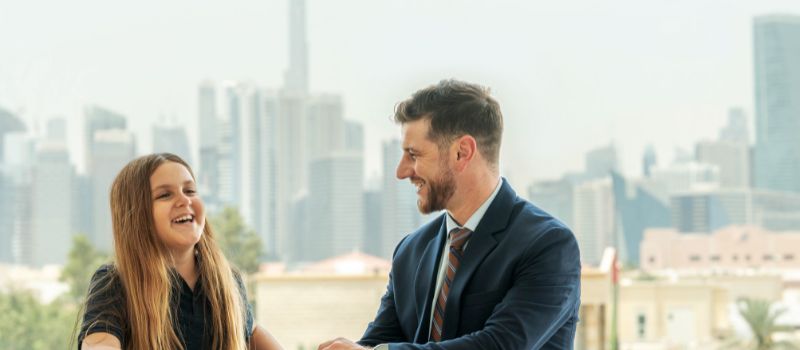
Edarabia had the opportunity to interview Scott Wilkinson, Founding Head of Primary at The Scholars School, to explore his vision for building a high-performance, inclusive Primary phase. In this conversation, he shares how strong routines, consistent teaching, literacy foundations, and character development are shaping confident learners, alongside insights into wellbeing, digital responsibility, personalised learning, and preparing young students for an evolving future.
My vision is to build a high-expectation, inclusive Primary phase where every child achieves highly, regardless of their starting point.
This is rooted in the belief that ability is not fixed and that, with the right teaching, all pupils can reach high levels of success.
Outcomes improve when we get the core classroom experience consistently right – through strong routines, clear explanations, and high-quality teaching. In practice, this is built through:
What makes it distinctive is the alignment- staff share a clear understanding of what great teaching looks like, and pupils benefit from that consistency every day. Over time, this builds not just strong outcomes, but confident, independent learners.
Our culture is built through what we consistently expect, model, and reinforce, particularly in the early years.
We prioritise respect, responsibility, and resilience, ensuring pupils develop not only strong behaviour but also the learning habits associated with high performance, such as perseverance, reflection, and independence.
From FS onwards, children experience structure, clarity, and predictability. This creates calm, purposeful classrooms where learning can thrive.
We do not leave culture to chance; it is explicitly taught, consistently reinforced, and modelled by every adult.
We position AI as a tool to enhance thinking, not replace it- fully aligned with our belief that great teaching remains the foundation of learning.
In Primary, the focus is on developing pupils’ ability to think critically about technology.
This includes:
Rather than teaching AI in isolation, it is embedded across subjects and aligned with our approach to explicit teaching and feedback. The priority is ensuring pupils remain active thinkers, not passive users.
The balance comes through education alongside clear boundaries.
We explicitly teach pupils when AI is appropriate and when it is not, how to question accuracy and identify limitations, and the importance of authentic work and academic integrity.
Alongside this, we establish clear expectations around use within school. This ensures pupils develop as responsible, independent users who understand both the opportunities and limitations of technology, and who maintain ownership of their learning.
These are central to the identity and values of the school, not additional elements.
We ensure strong alignment between Arabic and English literacy approaches so that language development is coherent and mutually reinforcing. UAE culture and values are embedded across subjects and reflected in daily school life.
At the same time, we create opportunities to celebrate diversity while building a strong sense of belonging and national identity. This results in a school culture that is inclusive, globally minded, and deeply respectful of the values of the UAE.
Where implemented effectively, I have seen clear improvements in focus, sustained attention, and face-to-face interaction, alongside a reduction in low-level disruption.
However, restrictions alone are not enough. They need to be supported by clear routines, consistent expectations, and explicit teaching around digital responsibility.
When implemented consistently across a school, the impact is not just behavioural—it significantly improves the quality of learning time.
Curiosity is strongest when pupils feel secure, successful, and appropriately challenged.
We create this through strong routines that reduce cognitive load, alongside clear, explicit teaching that builds confidence and understanding. Pupils are given regular opportunities for discussion, questioning, and deeper thinking.
At the same time, we deliberately develop the cognitive and metacognitive skills associated with High Performance Learning, such as reasoning, reflection, and flexible thinking.
Adaptive teaching ensures all learners are supported, while strengths are identified and built upon early. We maintain high expectations for all, increasing support rather than lowering challenge.
Wellbeing is supported through a combination of strong relationships and robust systems.
We use regular pastoral check-ins, clear communication between staff, and tools such as PASS to identify attitudes and potential concerns early. These are complemented by close partnerships with families.
Alongside this, a calm and predictable environment – driven by consistent routines – plays a key role in supporting pupils’ emotional wellbeing. This allows us to move from reactive to proactive support, identifying needs early and responding quickly.
Alongside strong academic foundations, particularly in literacy, pupils need to develop:
These align closely with the cognitive and personal skills defined within High Performance Learning and are developed deliberately through everyday classroom practice.
My legacy is to establish a high-performing Primary phase built on clarity, consistency, and high expectations, while drawing on the values, expertise, and educational legacy of Scholars International Group.
From the outset, this means embedding strong routines, establishing a shared understanding of what great teaching looks like, and building a culture where every child is empowered and supported to achieve their best.
Crucially, it means embedding the belief that high performance is an entitlement for all, not a select few.
If that culture is right, it creates the conditions for strong outcomes, confident learners, and sustained success well beyond the founding years.








 Twitter
Add a Comment
Please do not post:
Thank you once again for doing your part to keep Edarabia the most trusted education source.