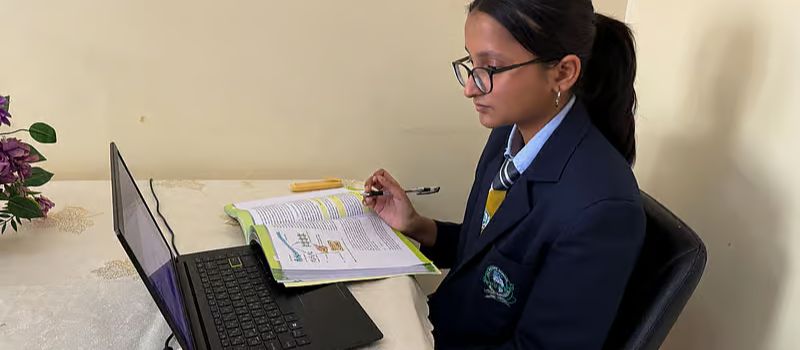
Schools are ensuring exam integrity using digital tools, while families juggle quiet spaces and pressure during assessments amid the distance learning shift
As UAE schools moved overnight to distance learning on Tuesday, thousands of senior students found themselves taking high-stakes exams not in classrooms but from their homes, under strict digital supervision.
The UAE had previously cancelled board exams such as IGCSEs, A-Levels, and IB final examinations for students due to sudden regional disruptions linked to the US-Israel-Iran conflict, which forced schools to suspend on-campus learning and switch to distance education.
After a brief period of calm, when schools resumed in-person classes on April 20, sudden emergency alerts issued across the UAE on May 4 prompted authorities to again prioritise student safety, leaving schools with little time to conduct traditional, in-person assessments that will be submitted to external boards.
But for schools and families, the sudden shift has been reassuring and has also presented certain challenges.
Arfarz Iqbal, a parent of a Year 11 student, explained that with external exams cancelled, schools are stepping in to fill the gap. His daughter’s school is now conducting internal assessments to build a portfolio for the UK board, giving students another chance to improve grades after earlier mock exams.
“Last week, these exams were conducted on campus. However, with the shift to distance learning, they are now being held online. Students must keep their cameras on at all times, with the camera positioned to clearly show their faces, hands, and the paper they are writing on.
“Teachers can randomly ask students to scan the room with their laptops, while the entire session is recorded. Students are not allowed to keep headphones or phones nearby,” added Iqbal.
Schools stress that maintaining exam credibility in a remote setting has been a top priority, with systems already in place helping ease the transition.
Maggie Perkins, Deputy Head (Secondary) at Nord Anglia International School Dubai, said platforms such as Exam.net have played a key role, as both staff and students were already familiar with them.
“Ensuring exam integrity in a distance learning setting has been a key priority. We’re using Exam.net. This means both staff and students have already been well-trained.
“This is supported by a robust online assessment policy, enabling us to minimise malpractice and maintain confidence in the validity of outcomes submitted to external exam boards,” added Perkins.
She added that early planning allowed schools to shift quickly without major disruption.
“Logistically, we’ve not faced any significant challenges. Early planning and prior training have meant we’ve been able to transition all Year 11 and Year 13 A-level students online quickly and smoothly.”
Dr Jinto Sebastian, Principal of The Apple International School, echoed similar sentiments, noting that structured systems were critical in maintaining standards.
“Ensuring the integrity and credibility of assessments within a distance learning environment remains a key priority for the school. Senior students are supervised through scheduled invigilation measures, real-time monitoring, and controlled assessment practices to minimise the possibility of malpractice.”
He added that quickly adapting to remote assessments required a coordinated effort. “The transition to remote high-stakes assessments required immediate alignment. Key challenges included adapting assessment systems within a limited timeframe. These were addressed through collaborative planning and clear communication with all stakeholders.”
While schools emphasise preparedness, parents emphasise that the home environment presents its own set of challenges.
Maria Santos, a Filipino parent, said her daughter’s school, where she is also a senior student, is relying on internal assessments submitted to the UK board, now conducted entirely online under strict guidelines.
“The assessments have now moved online, and students must remain on camera throughout. However, with everyone at home, maintaining a quiet environment throughout the entire exam duration can be difficult at times.
“Once the exam is over, students have to quickly scan and upload their answer sheets to the school’s system.
“I would say, despite the small hurdles, the systems in place offer a sense of continuity during uncertain times, ensuring students can progress academically,” added Santos.
© Khaleej Times


















 Twitter