


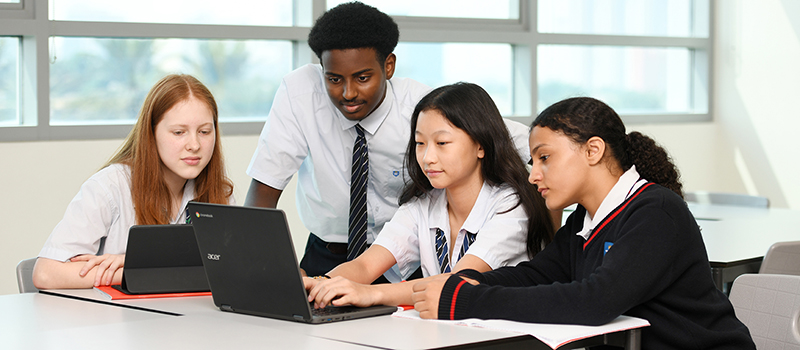
Walk into almost any classroom in Dubai, Riyadh, or Manama today, and you’ll witness one of the most diverse learning environments in the world, which reflects a living snapshot of our global society. In Dubai alone, over 90% of private school students are from outside the UAE, representing over 180 nationalities. Across the wider UAE, more than half (54%) of students come from beyond the Arab world. These classrooms are far from uniform. Students speak different languages, follow different cultural norms, and arrive with varying abilities and learning needs.
For educators, this diversity isn’t just a backdrop but shapes every decision in the classroom. Teachers are constantly adapting lessons, approaches, and resources to meet the needs of students with different languages, cultural backgrounds, and learning styles. And while this may appear as as a challenge, it in fact is an extraordinary advantage which cultivates agility, empathy, and problem-solving, in both students as well as in the educators guiding them.
Schools across the Gulf cater to students from every walk of life, from children of service workers, entrepreneurs, diplomats, and executives. They operate across British, American, IB, and national curricula, all while ensuring pathways to top universities worldwide. In this environment, one-size-fits-all solutions don’t work. Instead, schools have learned to design systems that can respond quickly to diverse needs.
The benefit is twofold. One in which students learn to navigate complexity and connect with peers from backgrounds vastly different from their own and the other where teachers develop adaptive skills, creativity, and cultural literacy, qualities that are increasingly critical in a globalized workforce. Today, adaptability has become one of the Gulf’s greatest educational assets, giving education systems that embrace complexity, a clear strategic advantage over those that do not.
Gulf education systems are also leading a quiet revolution in inclusion. In 2017, Dubai launched a roadmap to ensure all schools accommodated students with additional educational needs. By 2024, more than three-quarters (76%) of Dubai’s private schools were rated “Good” or better for inclusive provision. Ras Al Khaimah’s inclusive education policy brings all learners, regardless of ability or background, into mainstream schooling, while Saudi Arabia has introduced nationwide standards on assistive technologies, specialised teacher training, and classroom integration.
These initiatives go beyond compliance and signal a mindset shift. Schools that genuinely include diverse learners develop stronger collaboration and problem-solving capacity. Students who experience classrooms with children from varied nationalities and different learning abilities are inherently better at collaborating, thinking on their feet, and making sense of complexity. When diversity is embraced fully, both academic performance and student wellbeing improve.
The Gulf’s experience offers a blueprint for the future. Worldwide, demand for K–12 education is accelerating, with the global private education market projected to expand from about $2.5 trillion in 2023 to $3.8 trillion by 2032. Yet, many systems are slow to prioritize inclusion. UNESCO reports that fewer than 10% of countries have laws that ensure full inclusion in education.
In contrast, Gulf schools demonstrate that diversity is not a challenge to manage, but a resource to harness. When schools embrace multiple cultures, learning abilities, and social backgrounds, they cultivate agility, inclusivity, and excellence simultaneously. Students learn empathy and communication. Educators develop adaptive leadership. Schools build resilience that prepares them for an unpredictable world.
This means that the future doesn’t belong to the biggest educational systems, but to the most adaptable ones. The next chapter of global education will be written by school systems that can serve many different kinds of learners. If we are willing to learn from the Gulf’s experience, we can build schools that don’t simply keep up with a changing world, but help to shape it.
As nations confront shifting demographics, rising expectations, and technological disruption, the Gulf offers a vivid illustration of what’s possible. Its classrooms reveal that diversity is not a problem to solve, but a secret weapon. They show that by embracing complexity and inclusion, schools can create learners and educators capable of thriving in a globalized, fast-changing world.
If education systems around the world take heed, they will be positioned to lead change rather than simply react to it. The next generation of schools can be agile, inclusive, and globally relevant. And it starts with a simple principle, welcome difference, and let it shape the way we teach, learn, and grow.

Rob Tarn is an accomplished education leader known for his values-driven approach and proven impact on school improvement. His leadership has elevated educational outcomes for thousands of students, and his commitment to excellence continues to be recognised internationally. He currently serves as CEO at GEMS School Management, where he plays a key role in advancing the organisation’s mission to transform the lives of learners and deliver on GEMS Education’s vision for outstanding, future-focused schooling.









 Twitter
Add a Comment
Please do not post:
Thank you once again for doing your part to keep Edarabia the most trusted education source.