


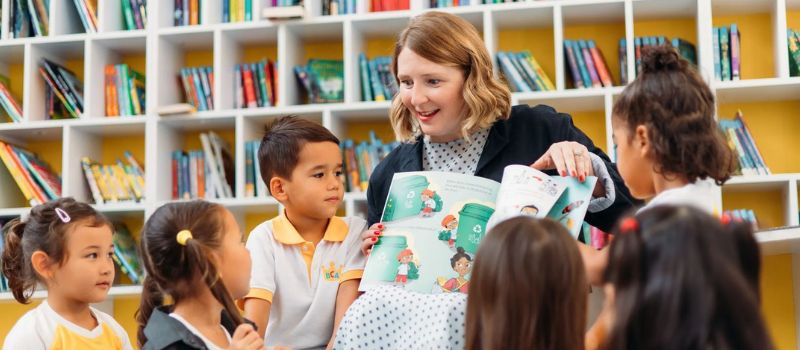
Edarabia had the opportunity to interview Zara Harrington, Principal of BC Academy International School, about how the school prepares students for the future. She shares how AI literacy, ethical thinking, and personalised learning develop curiosity, resilience, and confidence, helping students thrive academically, socially, and digitally.
At BC Academy, we’ve made a very conscious shift from simply using AI to actually teaching it. Within our British curriculum, AI is woven into our Future Tech lessons and innovation strands, as well as the tools such as nearpod, so students aren’t just clicking buttons they’re learning to understand what sits behind it. From EYFS through to Key Stage 3, we focus on building curiosity, strong questioning, and real problem-solving. As students grow, that naturally develops into analysing outputs, recognising bias, and designing their own solutions through our entrepreneurial curriculum strand. It fits seamlessly with our ethos of Belong, Challenge, Achieve. For us, AI isn’t about making things easier; it’s about thinking more deeply and learning better and efficiently.
As a new school, we actually opened without smartphones in the first place, so the national ban was a very natural alignment for us rather than a major shift. It simply reinforced what was already part of our culture.
Technology hasn’t disappeared; it’s just become intentional. At BC Academy, students use structured platforms and school-led tools with purpose, rather than defaulting to passive scrolling. This is the advantage of not even having access to ipads within the school. We have a purposely only used chromebooks to ensure we teach healthy habits from day 1.
Interestingly, the next conversation we’re having is actually with our parents. The challenge isn’t just students and devices, it’s the wider culture of constant connectivity and, if we’re honest, a fair bit of adult doom scrolling. So part of our role now is supporting families to
create healthier digital habits at home, because consistency between school and home is what really makes the difference.
Balancing AI restrictions really comes down to what is right for each stage of development. In Early Years and lower primary, our focus is firmly on language, creativity, and strong foundational thinking, aligned with our Curiosity Approach and inquiry-led learning. At that stage, children need to think, explore, and create without shortcuts.
As students move through the school, AI is gradually introduced through our innovation curriculum, but always with a clear ethical framework. By the time they are older, it’s not just about knowing how to use AI, it’s about understanding when it adds value and when it doesn’t. That judgement is the real skill, and it’s one we place a strong emphasis on.
At BC Academy, our approach to Arabic, Islamic Studies, and National Identity is deeply rooted in UAE heritage and closely aligned with our values of Belong, Challenge, Achieve. We see these subjects as fundamental to shaping character and identity. Islamic values such as respect, compassion, responsibility, and community sit naturally alongside our ethos, particularly in fostering a strong sense of belonging and purposeful growth.
We bring this to life through rich, real-world experiences. Students engage in heritage-based projects, enterprise linked to UAE industries, and authentic learning opportunities that connect directly to life in Dubai. A key part of this is our focus on art heritage through exhibitions, cultural collaborations, and creative expression, students explore the UAE’s history and identity in a tangible, meaningful way.
As a result, these subjects are not taught in isolation. They are lived, experienced, and understood. Students begin to see themselves as part of the story of the UAE, developing respect, cultural awareness, and a strong personal connection to the community around them.
When we talk about a future-ready student at BC Academy, we place a strong emphasis on social and interpersonal skills. Three non-negotiables for us are communication, collaboration, and confidence. In a boutique setting like ours, every child has a voice and we expect them to use it.
Confidence isn’t just about speaking up; it’s about listening well, working with others, navigating different perspectives, and building positive relationships. Students are regularly placed in situations where they need to articulate ideas, collaborate as a team, and take the lead when needed.
Through project-based learning, entrepreneurship opportunities, and everyday classroom practice, these skills are developed intentionally. The result is students who are not only academically capable, but socially aware, emotionally intelligent, and able to engage meaningfully with the world around them.
We deliberately move away from fixed career pathways and instead focus on developing an entrepreneurial mindset. At BC Academy, we want students to think creatively, take initiative, and see opportunities where others might see uncertainty.
Through coding, robotics, enterprise projects, and cross-curricular learning, students build a strong set of transferable skills, problem-solving, adaptability, collaboration, and innovation. They learn how to test ideas, take risks, and respond to challenges with confidence.
Ultimately, it’s about preparing students not for one specific job, but for a future that will continue to evolve. An entrepreneurial mindset gives them the tools to navigate that change and shape it.
Personalisation is one of our strongest USPs, and it is only possible because of our small school, small class size model. At BC Academy, every child is truly known academically, socially, and emotionally. We’re not working from spreadsheets alone; we’re working from real relationships.
Our teachers have the time and capacity to understand each learner in depth. We combine assessment data with daily teacher insight and ongoing dialogue with students to shape learning that is genuinely responsive. This means we can adapt quickly whether that’s providing targeted support, stretching high achievers, or nurturing a particular talent or interest.
In larger settings, personalisation can often become a system. Here, it’s a lived experience. Students are not one of many; they are individually recognised, challenged, and supported. It allows us to spot potential early, build confidence, and ensure every child is moving forward with purpose.
A key part of this is how we celebrate success. Our weekly Friday whole-school celebration assembly goes beyond academics, it recognises the whole child. We celebrate achievements in sport, creativity, leadership, kindness, and personal growth, ensuring every student has the opportunity to be seen and valued. This reinforces our belief that success is not
one-dimensional, and that every child has something meaningful to contribute.
Resilience is something we build every day, not something we leave to chance. Through our
B.C.O.R.E. approach, we make sure lessons include the right level of challenge, time to reflect, and a real sense of ownership for students.
We actively encourage children to have a go, to get things wrong, and to try again. That productive struggle is where the real learning happens. Students begin to understand that mistakes aren’t setbacks they’re part of the process.
Over time, you see a real shift. Children become more confident, more willing to take risks, and more open to change. Instead of feeling unsettled by challenges, they start to see them as opportunities to grow and that mindset stays with them far beyond the classroom.
When it comes to wellbeing, we keep it very real and very human. Our “boots-on-the-ground” approach means daily check-ins, strong pastoral systems, and most importantly staff who genuinely know their students and each other well.
Alongside this, our Be Kind curriculum runs through everything we do. It’s not a one-off lesson; it’s a consistent focus on empathy, respect, and how we treat one another. Students are explicitly taught how to recognise emotions, support peers, and build positive relationships and adults have time to connect with eachother.
What we’ve found is that it’s often the small things that matter most changes in attendance, a shift in behaviour, a quieter-than-usual child. Because relationships are strong, these don’t go unnoticed. We pick them up early, respond quickly, and put the right support in place. That early intervention is what makes the real difference.
We also have for staff a Superhero ticket that they can cash in at any time they are feeling overwhelmed and a senior leader will cover their lesson for them. Its the little touches that make the difference.
For Students of Determination, our focus is firmly on achievement. Inclusion is not enough. Through targeted support, personalised pathways, and high expectations, students are supported to excel within the mainstream setting. Our inclusive ethos ensures every child feels they belong and can achieve.
Digital citizenship is taught explicitly. Students are guided to build a digital identity that reflects their values and aspirations. In a world shaped by technology, this is not optional it is essential.
Parents at BC Academy are very much part of the learning journey, not just observers of it. We work hard to make that partnership practical and meaningful. For example, through our online platforms, parents can see learning in real time—what their child is studying, how they are progressing, and where they may need support. It moves conversations at home from ‘What did you do today?’ to much richer discussions about learning.
We also involve parents directly in key moments of school life. Our Friday celebration assemblies are a good example, parents are invited to share in recognising achievements beyond academics, whether that’s sport, creativity, or acts of kindness. It helps reinforce a shared message about what we value as a school.
During hybrid and online learning periods, that partnership becomes even more visible. Parents support routines at home, help younger children access lessons, and communicate regularly with teachers. We provide clear guidance so they feel confident in that role, rather than overwhelmed.
We also create opportunities for parents to engage through workshops, events, and community initiatives, whether that’s curriculum evenings, wellbeing sessions, or cultural celebrations linked to UAE heritage and Islamic values.
Ultimately, when school and home are aligned, children feel it. They feel supported, understood, and more confident and that’s when they thrive.
For staff, the pace of change can be overwhelming if not managed well. So we focus on clarity and practicality. Not every new initiative is adopted only those that genuinely improve teaching and learning. Professional development is ongoing, supportive, and collaborative.
The goal is confidence, not compliance.
If I could leave one message for our school community and beyond it would be this: the strength of a school is not measured by buildings or results alone, but by the quality of its relationships.
At BC Academy, we are intentional about building a community where everyone feels they belong, students, staff, and parents alike. Because when people feel valued, they contribute more, collaborate more, and grow together. Education is not something that happens in isolation; it is a shared responsibility, and when we move in the same direction, the impact is far greater.
In a world that is constantly evolving, what will sustain us is not just innovation, but connection. It is how we support one another, how we communicate, and how we model the values we want to see: kindness, respect, resilience, and integrity.
So my message is simple: invest in people. Build trust. Stay curious. And never underestimate the power of a united community working with purpose.
Because when a school community is strong, everything else follows.







 Twitter
Add a Comment
Please do not post:
Thank you once again for doing your part to keep Edarabia the most trusted education source.