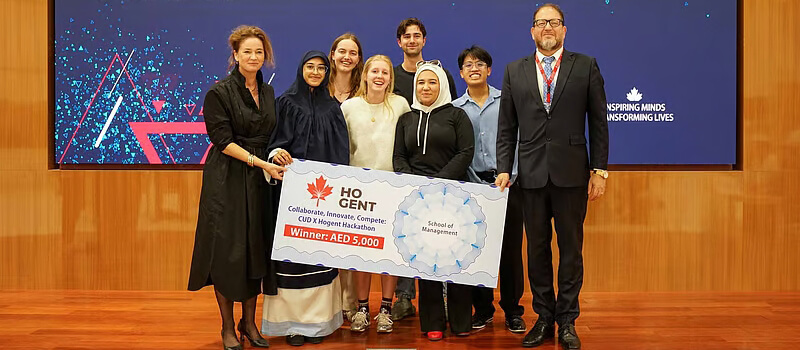
In Dubai, a staggering 38 per cent of prepared food is wasted, a figure that rises to around 60 per cent during Ramadan, with food making up nearly 40 per cent of typical household waste.
One notable initiative, Foodloop, is a social business concept aimed at addressing the food waste crisis by creating sustainable solutions to reduce waste and promote responsible consumption.
Explaining the concept, Aamena Tinwala, who is pursuing Public Health at Canadian University Dubai (CUD) said, “The idea is centred around collecting food waste from households and businesses that would otherwise have been thrown away. We propose upcyling, recycling or reusing the waste by turning it into products and materials such as animal feed, fertilisers, biodegradable containers, plates, cups, and utensils, which will be our source of income to run the business. This allows us to not only reduce the impact of food waste but also reduce the consumption of single use items. Other than using food waste for products, we can also explore its use in energy and fuel production allowing for endless possibilities.”
Other team members, included Sebastien Kirk Uy from CUD and three students from HOGENT University, Belgium — Maxim Derom, Sarah Lootens, and Marit Holvoet.
The students emphasised that their idea aligns with SDG 11, which aims to create inclusive, safe, resilient, and sustainable cities and human settlements.
Another team member, Farha Mohamed Rashad from CUD added, “Our primary goal is to support the industry and contribute to the urban development. Instead of relying on garbage trucks for collection, we plan to introduce designated bags for food waste, allowing us to collect it directly maybe from pick-up trucks.”
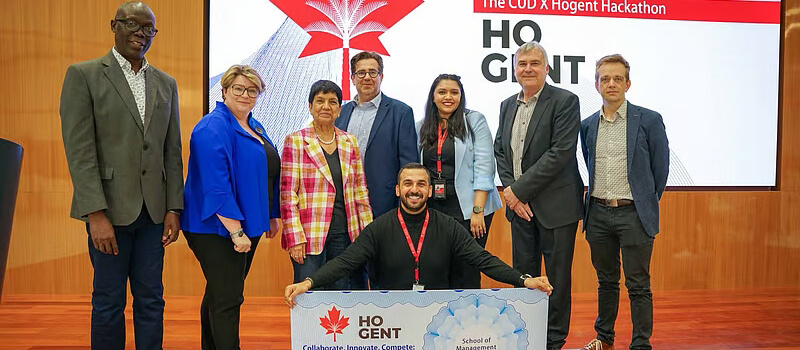
For this purpose, the students intend creating an app. “I believe this could be ready by next Ramadan. We still need to figure out how to distribute the bags for food waste disposal or possibly arrange for drivers to collect them. This waste can then be recycled into plastics, energy, or other useful products. For example, potato and seafood shells contain a polymer-like compound, that can be extracted and repurposed into biodegradable plastic,” she added.
Meanwhile, another project in the varsity, focuses on improving public transportation usage through a rewards-based system.
The associated mobile app aims to provide real-time updates, route optimisation, and integrate fare systems for a seamless commute.
Qasim Al Khafaji, Team Leader, Canadian University Dubai Student, International Business, said, “People can earn points for using public transport, redeemable for discounts on future rides, partner services, or retail stores. Our mobile app will offer real-time updates, route optimization, and an integrated fare system for a seamless commuting experience.”
This project has been developed by Qasim Qasim and Nathan Kahsay Kidanu, with HOGENT University, students, Jules Devriese, Nagui Langeraert and Lisenka Vansteenbrugge.
“This initiative goes beyond a mobile app; it’s a strategic effort to build bridges between public and private sectors, fostering community engagement and supporting sustainable urban growth,” added Khafaji, who is a second-year International Business student.
The solution aligns with Dubai’s zero-emission public transport goals and low-emission policies, promoting green mobility solutions.
The project was led by Professor Dr Kiran Tangri, who said, “This exemplifies the power of innovative thinking and collaborative teamwork. By combining technology, behavioral incentives, and urban planning, we are paving the way for a more sustainable and efficient urban transportation system.”
© Khaleej Times











 Twitter