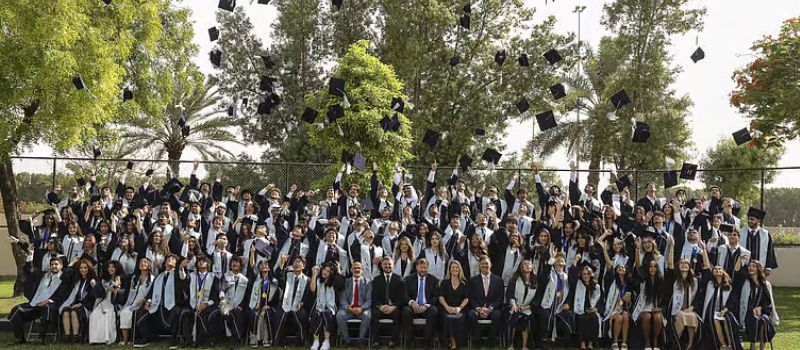
UAE IB students delivered one of the country’s strongest performances, surpassing global averages and securing places at leading universities worldwide
As thousands of students across the UAE logged in to receive their International Baccalaureate (IB) results this week, the Class of 2026 marked the end of a school journey unlike any other.
These students began their secondary education during the Covid-19 pandemic and completed it amid regional tensions that led to the cancellation of final IB examinations across the Middle East. Yet despite the disruption, UAE students recorded another year of exceptional results, significantly outperforming global averages.
According to figures released by the International Baccalaureate Organisation (IBO), 3,278 UAE students achieved an average Diploma Programme (DP) score of 34.5 points, well above the global average of 30.88 points. The UAE pass rate reached 98.32 per cent, while 428 students scored 40 points or higher — a benchmark widely regarded as a gateway to some of the world’s most competitive universities.
Globally, more than 209,600 students received their IB Diploma or Career-related Programme (CP) results this year, with the number of candidates increasing by 3.7 per cent compared with 2025.
This year’s results carry particular significance because students were assessed through the IB’s Non-Exam Contingency Measure (NECM) after final examinations were cancelled due to regional instability.
Instead of traditional written exams, final grades were determined using evidence gathered throughout the two-year programme, including coursework, internal assessments and externally moderated assignments.
While the assessment model changed, educators stressed that academic expectations remained unchanged.
Students were still required to demonstrate the analytical thinking, research skills, academic rigour and independent learning that underpin the IB curriculum.
The Class of 2026, therefore, becomes one of the few cohorts in recent history to have experienced major disruptions at both the start and end of their secondary education.
For parents, the results offer reassurance that universities continue to recognise and value IB qualifications awarded through the contingency process, with grades based on extensive evidence accumulated over two years of study.
Several UAE schools reported standout performances, with multiple students achieving the maximum score of 45 points.
Among the strongest performers was Jumeirah English Speaking School (JESS), which recorded an average DP score of 38 points, with 99 per cent of students scoring above 30 points and 34 per cent achieving more than 40 points.
North London Collegiate School Dubai also achieved an average of 38 points, with 84 per cent of students scoring above 35 points and 37 per cent exceeding 40 points.
Within the GEMS network, GEMS Wellington International School posted an average score of 37 points, while Nord Anglia International School Dubai achieved 37.1 points and a perfect pass rate.
Other notable performers included:
Sunmarke School Dubai – 36.4 average points, 100% pass rate
Dubai International Academy Emirates Hills – 36.3 average points, 100% pass rate
Ambassador International Academy – 36.31 average points, 100% pass rate
Aspen Heights British School Abu Dhabi – 36 average points, 100% pass rate
Deira International School – 35.7 average points, 100% pass rate
Swiss International Scientific School – 35.6 average points, 100% pass rate
Across major school groups, including GEMS Education, Innoventures Education, Nord Anglia Education, Taaleem and others, schools reported near-perfect or perfect pass rates.
Innoventures Education, which includes Dubai International Academy schools and Raffles World Academy, recorded a combined average score of 35.8 points among 311 Diploma Programme candidates, with four students achieving the maximum score of 45 points. Their students also secured more than USD 15 million in university scholarships.
Students enrolled in the IB Career-related Programme (CP), often combined with BTEC Level 3 qualifications, also achieved impressive outcomes.
Schools, including Jumeirah English Speaking School, Raffles World Academy, Dubai International Academy Emirates Hills, British International School Abu Dhabi, Deira International School and Bloom World Academy, reported 100 per cent pass rates.
JESS stood out with 92 per cent of entries awarded Distinction, while Raffles World Academy recorded 81 per cent Distinction grades. Swiss International Scientific School reported 95 per cent of students achieving Distinction.
The strong CP and BTEC results reflect growing recognition among parents that multiple pathways can lead to university success and career readiness.
The 2026 results reinforce the UAE’s position as one of the world’s strongest IB markets, with schools continuing to record average Diploma scores above global benchmarks.
The International Baccalaureate Diploma Programme, designed for students aged 16 to 19, combines six academic subjects with a core that includes the Extended Essay, Theory of Knowledge and Creativity, Activity, Service (CAS).
Richard Drew, Chairperson of the UAE IB Association and Principal of Jumeira Baccalaureate School, said this year’s cohort had shown exceptional resilience during a challenging academic year.
“The Class of 2026 has demonstrated remarkable resilience, determination and maturity throughout an academic year shaped by significant regional challenges. Despite unprecedented disruption, our students remained committed to their learning, embodying the curiosity, compassion, critical thinking and adaptability that define an IB education.”
He added that all UAE IB schools were supported through the International Baccalaureate’s Non-Exam Contingency Measure, introduced following conflict-related disruption.
“The results awarded are fully recognised IB results, reflecting the IB’s rigorous quality assurance processes and its commitment to ensuring students can continue their educational journeys.”
For students who achieved the coveted 45-point perfect score, success came down not just to ambition but consistency, discipline and a focus on learning.
Samarth Singh Juneja from GEMS Modern Academy, who achieved 45 points, said he entered Grade 12 with a clear goal but did not view the score as the ultimate achievement.
“Honestly, to some degree, yes. I was not fixated on it, but I walked into Grade 12 knowing I wanted the 45, and more importantly, knowing exactly what it would take to get there.”
He said the key was shifting focus from chasing marks to understanding concepts.
“The moment I stopped obsessing over what score a topic might ‘give’ me and just focused on genuinely understanding it, the marks had a funny habit of sorting themselves out. Chase the knowledge, and the pointer follows on its own.”
For Dubai International Academy Al Barsha student Nour Bilal Al Husseini, the final stretch of the IB programme involved long hours and personal sacrifices.
“Typically, after school, especially during the Internal Assessments (IAs), I worked a lot of extra hours, till 2am sometimes. The coursework required a lot of effort, so I’d have to work hours upon hours,” she said.
Like many IB students across the region, she experienced mixed emotions when final examinations were cancelled.
“It was a bittersweet moment when the exams in the GCC got cancelled. On one hand, we didn’t have to study anymore, but at the same time, I was very disappointed because I put in so much effort in the last two years.”
“But it didn’t matter eventually because in the end, my hard work did pay off.”
For many families, IB results are more than just grades. They determine university admissions, scholarship opportunities and access to highly competitive programmes in medicine, engineering, business and law.
Historically, scores above 35 points have been considered strong by many leading international universities, while scores above 40 place students among the highest-achieving IB candidates globally.
This year, many UAE schools reported significant proportions of students crossing these benchmarks, highlighting the continued strength of the country’s IB sector.
The results also highlight the growing popularity of the IB pathway in the UAE, which has become one of the largest IB markets globally, offering parents a curriculum recognised by universities across North America, Europe, Asia and Australia.
© Khaleej Times

















 Twitter