


Kide Science Co-Founder and GESS Dubai Speaker, Aino Kuronen, shows us how children’s play methods and hands-on science learning can make a difference in this exclusive interview with Edarabia. According to Aino, with the right balance of fun and learning, we can discover children’s true potential.
1. The education system in Finland is consistently ranked as the world’s best, particularly in terms of promoting holistic learning. Having spent 5 years teaching in Helsinki, what are some lessons learned that could be implemented here in the UAE?
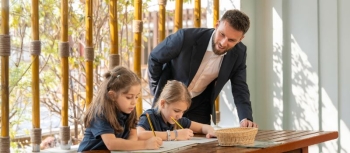
My teaching experience in Finland has taught me that a young child has a lot more capacity than we adults think, especially when we talk about science. They have a certain open-mindedness to situations where they face a scientific problem maybe because the early years are the most important learning years and there is a lot of problem-solving situations in children’s everyday lives anyway. We should give them a chance to solve problems by using methods that are natural for them, by using play and hands-on methods. I think that this kind of attitude, letting children try instead of listening, would sbenefit all educators.
2. STEM careers are still mostly dominated by men. As a science educator, how do you encourage young girls to participate in STEM activities, such as coding and robotics?
We try to empower all children by treating them in a way that we respect their suggestions, we listen to their ideas and we go to their level. When we teach science to children, we refer to them as scientists and adults are just research assistants. We want to shift the focus to the child and their learning. I must say I almost cried when a young girl came to me and my colleague and said: “I am going to be a scientist because you are!” That was a very powerful moment in my career.
3. How have you implemented pedagogical development for science learning in a school located in the UAE or in the MENA region? What have been some of the positive outcomes?
We haven’t yet had a chance to implement our pedagogical model in the UAE and MENA region, but we have already started in Malaysia, Singapore, Australia, China and Finland, and are now heading to the MENA region. We just got a deal to work with Finnish daycare centers in Kuwait and Saudi Arabia. We are very close to being present in the MENA region.
We got a lot of feedback about children being engaged in learning and at the same time having a lot of fun. One recent feedback crystallises the feedback we usually get: “It was the perfect balance of fun and learning. My daughter was focused and totally engrossed in the fun experiments. I loved that she was learning from a researched program, and having a ball doing it!”
4. Can you tell us more about your session at GESS titled “Kide Science: Young Child as a Scientist”? What can visitors expect to learn from the session?
My aim is to get people engaged in the importance of this topic because teaching science to young children benefits the learning path of a child in the future. I am going to talk a lot about playful methods, focusing on teaching science skills and using hands-on learning in science education. This is a topic very dear to me and I believe it is very beneficial to society, and I want this to be the message when people visit my session at GESS.
Will technology replace teachers in the future? (GESS 2020)
Aino Kuronen is from Helsinki University, Faculty of Education. She specialises in storytelling in science education. Her career background is in elementary school, special needs and science education.
Aino’s career as a science educator for young children started five years ago. She has designed lesson materials, pedagogical development for science learning environments, coordinated science clubs and taught science lessons. In 2018, Aino founded Kide Science. She now uses her knowledge for pedagogical design and product development. She has participated in numerous public speaking engagements and became one of the hosts of the children's science TV show called "Tiedonjyvä" in Finland.




 Twitter
Add a Comment
Please do not post:
Thank you once again for doing your part to keep Edarabia the most trusted education source.