
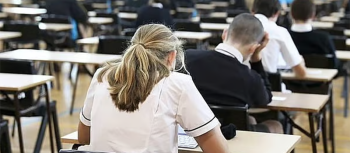
Hundreds of pupils in the UAE may have to sit vital exams that determine their admission into US universities online this year, due to the coronavirus outbreak.
Each year, roughly three million pupils worldwide take the SAT, or Scholastic Assessment Tests, which is a mandatory exam for entry into a US university. Scheduled for March, May and June, this year’s exams, which are typically written, were cancelled due to the Covid-19 pandemic.
The College Board in the US, which conducts the internationally recognised exam, has said the SAT may be held online this year if schools do not reopen by autumn.
But teachers in the UAE say this would require children to learn new techniques and pupils are concerned they may underperform and jeopardise their college applications.
Peter Davos, founder of Hale Education Group in Dubai, said pupils who wish to attend top universities will have to study through the summer if the SAT are held in August. About 300 Hale pupils plan to take the SAT this year.
Because of Covid-19 SAT cancelations, we’re planning an additional September SAT and preparing to significantly expand capacity for all fall administrations.
If schools don’t reopen this fall because of Covid-19, we’ll provide a digital at-home SAT.
“Many colleges and universities will make the tests optional but top universities would still require SAT scores,” said Mr Davos.
“Students who have been complacent may they think that appearing for SAT is an option and they do not need to worry about taking these.
“Pupils who are preparing diligently will have multiple opportunities,” he said.
Mr Davos said a proctor or examination officer may have to be assigned to monitor pupils online and ensure they do not cheat. Some universities in the UAE have asked students to turn on webcams during exams to avoid any cheating but some have argued this is an invasion of privacy.
“The resources are not available yet but we will help pupils prepare for the online tests,” he said.
Not all universities in the US require SAT a a requirement for admission. Tufts University, Boston University and Northeastern University made SAT scores optional for pupils even before the pandemic.
But top institutes including Harvard University and Yale University require SAT scores for entry.

Katharine Vavpetic, chief executive of GEMS United School Dubai, said moving the tests online would likely mean more more US colleges and universities would eliminate them.
“Pupils at GEMS Education schools will be affected. This is a major shift in how pupils interact with and think about the SAT test,” she said.
“Eliminating the SAT as an admissions requirement would help pupils who have test anxiety. But, if SATs are to be given online, pupils will be able to control their own testing environment, reducing anxiety.”
She said online testing could have negative effects on pupils’ scores due to inequalities in access to testing environments at home and reliable internet access.
“Parents and pupils may be concerned about online privacy if, during an online SAT, cameras and microphones are recording the student and his/her environment. These are questions the College Board is going to have to resolve,” she said.
“If privacy concerns, test integrity concerns, and equity concerns are addressed, then online SATs may work well, but I think it’s too early to tell.”
Vishal Kavitha, a year 11 pupil at Jumeirah College, was planning to take the SAT in August ahead of going to university in 2022.
“This is part of the admission preparation for US universities and I am hoping to study aeronautical engineering at Stanford University or Massachusetts Institute of Technology,” said Vishal, 16.
“I would definitely not be happy to sit the exams online as it’s a complete game changer.
“It’s a race against time and I have learnt techniques for the tests done on paper. This is completely new so I would have learn techniques for the online version.
“More people will skip the exam and people who sit for it this year might have a higher chance of underperforming. It’s a new platform so there may be increased room for error.
“I would do better if it’s on paper so I will wait.”
Rami Hamzeh, a year 11 Canadian pupil at Raffles International School, agreed that switching to an online test would pose challenges.
“I may have to take it multiple times so taking it online initially does not matter much to me. But, if they cancel SATs later that may affect my higher education plans,” said Rami, 15.
“It will need more effort especially in the reading section. I would rather take the exam on paper,” he said.
Rami plans to pursue bachelors studies in pre-law in the United States or Canada.
“Based on the practice tests my results are consistent regardless of whether I do it in paper or online so I can make the switch,” he said.
Universities and schools in the UAE implement distance learning after being closed since March

© The National






 Twitter