


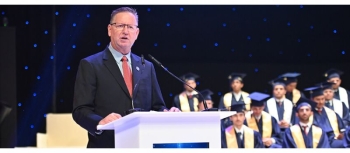
Edarabia had the opportunity to interview Steve Lupton, Head of the Australian International School in Singapore, to explore how the school is navigating AI integration, digital readiness, and future-focused education. In this conversation, he shares how AIS is balancing innovation with academic integrity, strengthening student wellbeing, and fostering adaptability, critical thinking, and character in a rapidly evolving global landscape.
We have taken a very deliberate and structured approach to AI both at AIS and across Cognita schools globally.
Through our partnership with Flint AI, we are not simply introducing another tool we are shaping how AI is used in an educationally sound way. This work has been led by our global education team under Dr Simon Camby, who has been closely involved in the design to ensure that academic integrity and safeguarding are built in from the outset.
At AIS we are currently in a phased rollout. A group of early adopter staff are already using Flint AI to explore how it can enhance teaching and learning in a controlled and thoughtful way. Over Term 2 all staff will receive training focused on effective responsible use before we move to a staged introduction for students aged 13 and above.
Alongside this, we are very clear with students about the purpose of school. It is not simply to produce answers it is to develop better thinkers and problem solvers and ultimately to help young people grow wiser. Those fundamentals have not changed because of AI. If anything, they have become more important.
AI can support the process but it cannot replace the thinking. That is the line we hold.
We have moved away from the idea that more technology equals better learning.
Instead we focus on intentional use. There are times when devices enhance learning and times when they distract from it. Our approach is structured with clear expectations in classrooms, age appropriate boundaries, and a strong emphasis on balance.
Equally important is protecting human interaction. Some of the most powerful learning happens in discussion, debate, and collaboration without a screen in sight. We want students to be just as confident engaging face to face as they are online.
This is where the structure we have put in place really matters.
Through our work with Flint AI, the guardrails are not left to chance. There are clear frameworks around how AI can be used, when it should be used, and where the limits are particularly around academic honesty and independent thinking.
But beyond systems this is about education. Students are explicitly taught how to use AI with integrity how to question outputs, recognise bias, and understand that the quality of what they produce still depends on the quality of their thinking.
We also spend time reinforcing that school is not just preparation for exams or even careers it is about developing the habits of mind that allow you to navigate complexity, make good decisions, and contribute meaningfully.
The phased introduction, starting with staff and then moving carefully to students over 13, allows us to build that understanding properly. We are not rushing it. We are getting it right.
Ultimately our responsibility is not just to give students access to AI, but to ensure they are thoughtful, ethical, and capable users of it in the world beyond school.
For me, strong foundations are non-negotiable, but they must be relevant and connected.
At AIS we are supported by the strength of the IB learner profile, which provides a powerful framework for developing internationally minded young people. It is not just about what students learn, but who they become open minded, reflective, principled, and able to engage with different perspectives.
In subjects like English, Mathematics, and the humanities, we anchor learning in real world contexts that reflect the diversity of our community. Students see themselves in the curriculum, while also being challenged to think beyond their own experiences.
If I had to narrow it down to three they would be critical thinking, adaptability, and character.
Students need to be able to question, analyse, and make informed decisions. They need to be comfortable with change and able to respond to it. And importantly, they need a strong sense of integrity, empathy, and responsibility.
Competence without character is not enough, its actually dangerous. That balance really matters.
We are very clear that we are not just preparing students for a single pathway we are preparing them for a lifetime of change.
As a school, we are deliberately developing skills, knowledge, and importantly character traits that are transferable across any context. The ability to think critically, communicate effectively, and act with integrity will remain relevant regardless of how the job market evolves.
What makes AIS particularly strong is our environment. Our students are learning in a genuinely diverse international community, which naturally develops open mindedness, tolerance, and respect for others. These are lived experiences day to day.
That combination of transferable capabilities and global perspective positions our students strongly for future success in international and multinational organisations.
We recognise that success looks different for every student, which is why breadth and choice are so important.
At AIS, students benefit from multiple pathways, including both the HSC and the IBDP, allowing them to pursue routes that align with their strengths and aspirations.
Alongside this, we offer a broad curriculum that spans academics, the arts, sport, and co curricular opportunities. Whether a student’s strengths lie in the classroom, on the stage, on the field, or across a combination of areas, there are opportunities for them to develop and excel.
Our role is to provide those opportunities and guide students in discovering where their strengths lie.
Resilience is not something you can teach in isolation it has to be experienced.
One of the most powerful ways we do this at AIS is through our extensive outdoor education and overseas trips programme. These experiences place students outside of their comfort zones, where they are required to adapt, collaborate, and persevere.
Whether it is navigating unfamiliar environments, working as part of a team, or overcoming physical and mental challenges, students develop a deeper understanding of themselves and their capabilities.
Combined with a strong culture of feedback and support in the classroom, this helps students see challenge not as something to avoid, but as something that drives growth.
We take a proactive approach to wellbeing.
Regular check ins, pastoral tracking, and wellbeing surveys allow us to identify concerns early. Staff are supported to notice changes and respond quickly.
We also have a dedicated wellbeing structure aligned ensuring that support is systematic and embedded in daily school life.
Inclusion starts with access.
For students who are non native English speakers, we provide targeted English foundation and preparation programmes to ensure they can fully access the curriculum. This is critical for both confidence and long term success.
Alongside this, we use personalised approaches, including individual learning plans and targeted support, to meet the needs of all learners.
The aim is to ensure every student has the opportunity to succeed and feel a genuine sense of belonging.
Students are explicitly taught that their digital presence is part of who they are.
We focus on digital citizenship, how to communicate respectfully, think critically about content, and understand the long term impact of what they share.
It is about giving students the awareness and judgment to navigate the digital world confidently and responsibly.
Strong schools are built on strong partnerships with parents.
At AIS, we create meaningful opportunities for parents to engage directly with learning. In Term 1, we invite parents into classrooms through our Celebration of Learning, giving them real insight into their child’s experience.
Our Parents’ Association is also deeply involved in the life of the school, organising significant events throughout the academic year and helping to build a strong sense of community.
Professional development is integral to any profession, but even more so in one as vital to society as teaching.
At AIS, we place a strong emphasis on continuous improvement through coaching, collaboration, and structured professional learning. We are currently embedding our whole school pedagogical framework, Teaching for Impactful Learning and Progress.
This is about building on expertise, not replacing it. Strong pedagogy remains at the core, and new approaches and technologies are there to enhance that, not distract from it.
The pace of change in the world is undeniable, and schools must continue to evolve.
But we must not lose sight of what matters most. Education, at its core, is still about relationships. It is about people, connection, and the development of character.
If we can ensure that young people grow not only to be capable, but also kind, ethical, and grounded, then we are doing our job well. While the world will continue to change, those human qualities will always matter.






 Twitter
Add a Comment
Please do not post:
Thank you once again for doing your part to keep Edarabia the most trusted education source.