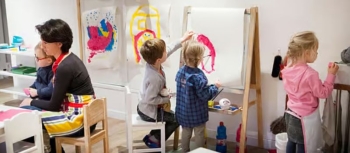
The P.O.D.O. Club is an early learning program for individuals. Our goal is to foster the development of our children in becoming physically and emotionally healthy individuals. Our program integrates many aspects of learning – especially the creative arts – to bring forth steady and good growth in all social, physical, and intellectual dimensions of the children's life.
The P.O.D.O. Club believes that as a child plays and interacts with his/her environment, he/she constructs meaning about how the world works. In other words, children take charge of their own learning.
The P.O.D.O. Club believes as a neuron scientist confirms – that from birth to age six, development in all areas is more rapid than at any other time in life. Nurturing guidance and attention to every part of a child’s development during this crucial stage helps them acquire not only math and reading proficiency, but also compassion, strength, independence, resilience, and a love of learning - qualities that are easy to take for granted, but are crucial for success beyond preschool. Therefore, not only academic learning– such as reading, writing, math, and science– but also learning functional values– such as how to share and show self-control, how to focus and transition smoothly from one activity to another, how to empathize with others’ feelings and resolve conflict effectively– are just as important.
The P.O.D.O. Club believes that children learn best through direct experiences. We practice a progressive philosophy, based on the work of John Dewey, by providing abundant opportunities for experiential learning. Through these hands-on activities, children are encouraged to learn to think, reason, question, and experiment in a nurturing and supportive environment.
The P.O.D.O. Club believes the early years lay the foundation for a wide range of later developmental outcomes that truly matter. Among those important things are self-confidence, sound mental health, motivation to learn, and achievement in school.
The curriculum is based on the belief that children learn through play, active manipulation of their environment, life experience and communicating with peers and adults. It is designed to facilitate children’s involvement in their own learning.
The P.O.D.O. Club uses theme-based learning to engage children in the learning process with a variety of lessons in subjects from art and music to science and math. A common theme keeps children learning, focused on a broad concept while touching on specific knowledge and skills throughout. We believe that using theme-based learning is one of the best approaches for integrating content in a way that makes sense to the student, helps them make connections, and transfer knowledge that they learn and apply it in meaningful way to their lives.
Theme-based learning allows students to delve into one particular subject in all curricular areas. Under a woodland animal theme, the topic of hibernation could include a science lesson about which animals hibernate where, a song about hibernation, an art project of a bear in a cave and a math activity where the children add and subtract bears. When the same theme occurs across the curriculum, the children are able to revisit the same ideas and apply them in different ways, resulting in a richer understanding of the subject.
Our objective for White class is to facilitate toddlers to learn about their emotions and encourage them to express their feelings.
The class will have different types of activities and crafts to help the students understand different aspects of emotions.
For more information about our Daily Schedules and our Classroom Lesson Plans, please make an appointment with the office.
For Green and Orange Classes, our objectives are to guide them with crafts and activities that will enhance their thinking skills and to nurture the children's general knowledge of the world.
For Purple and Grey Classes, our objectives are to start experimenting with the world with the knowledge we have and to explore new depths by every day experiences.
Yellow Class will support their social, emotional and cognitive development.
Blue Class will be expected to complete assignments with less outside help, accept more responsibilities, and follow rules more closely.
Navy Class' goals focus on children building strong pre-reading skills, practicing letter formation, enhancing listening and communication skills, getting an introduction to basic math concepts, and acquiring an active interest in the world.








 Twitter
Studied or Worked here? Share Your Review
Please do not post:
Thank you once again for doing your part to keep Edarabia the most trusted education source.