
Dubai Cares will be providing a grant of Dh5 million to the Digital School that was primarily launched to empower refugees and underserved students across the region and the world.
The Digital School, which falls under the Mohammed bin Rashid Al Maktoum Global Initiatives (MBRGI), is further collaborating with global players, to enhance the quality of online education across the Arab world, making it the first comprehensive Arab online school.
In its subsequent phases, it will be partnering with the Arizona State University in a bid to attract the best resources, with world-class trainers adept at teacher training, especially for the online platform.
Speaking at a press conference on Monday, that was held at Dubai Expo 2020, His Excellency Omar Al Olama, UAE Minister of State for Artificial Intelligence, Digital Economy and Remote Work Applications and Chairman of the Board of Directors of the Digital School said, “We’ve also worked on training the teachers in partnership with Arizona State University, giving them the best training possible to ensure that they benefit from the education journey on the platform. We’ve also signed agreements with five countries including Egypt, Iraq and Jordon to ensure the deployment of the platform.”
He added, “Finally we are aiming to have 20,000 students for this year. We also aim to have 500 teachers to facilitate during this year. We are going to have a significant increase in the number of students in the coming years. 20,000 in year one, 100,000 in Year two, 300,000 in Year three and 600,000 in Year four and 1 billion students by the end of first year.”
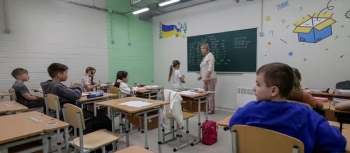
It aims to provide access to classes powered by cutting-edge technologies and Artificial Intelligence to students anywhere in the world, particularly underserved communities.
The platform aims to blend live and self-paced virtual classes in Math, Science, Arabic, Computer Studies, and English. It provides learning models, processes and material that are compatible with national and international curriculum.
It will include interactive simulation, game-based learning, and AI-driven adaptive learning modules.
Elucidating on this Dr Abdulla Al Karam, Director General at the Knowledge & Human Development Authority (KHDA), said: “We focused on serving the stakeholders, the students, and the teachers. We also focused a lot on working with the local education bodies of the countries that we are working with to ensure that the content gets digitized as per their standards and outcomes which has been done. But parallelly also working with international accrediting bodies so that they get global recognition for their outcomes.”
Dr Karam then opined: “We are confident that one of the key sustainable elements of this programme are the teachers themselves. They are not only knowledgeable about the subject but also about the technology to ensure that maximum benefit is being realised. We have partnered with Arizona State University who happen to be the best in teacher training especially online. We want the right teachers with international qualification to give the right training. We assure that the content is up to the international standards.”
Dr Tariq Al Gurg, CEO of Dubai Cares and member of its board of directors highlighted on how it’s a digital platform, not a school that provides education to children and youth in countries anywhere, where children are not privileged financially to get education, “children who are on the move and displaced within their own countries and are in rural areas where there is no other schooling system other than a digital world to get education,” he added.
By engaging and interacting with licensed educators, as well as providing a smart evaluation mechanism, students will develop life-long autonomous learning skills.
“We are putting an IT system, an infrastructure that caters to any need. If a country has a certain criterion on how they can adopt and come into the system by sharing their own technologies, we have the flexibility to customize how this integration will happen. Everything related to logistics, speaking to the government, and mapping out is done by Emirates Red Crescent. Dubai Cares will be giving a grant of 5 million dirhams to the Digital School,” Gurg added.
The UAE Red Crescent is one of the key partners supporting the establishment with 1,000 learning space for the digital school over five years. This comes alongside collaborations with Dubai Endowment and Arizona State University where over the course of the next three years, the Digital schools will work with 1,500 certified educators.
Shedding light on international collaborations Dr Gurg says, “What is left now is to bring global partnerships to be in this whole ethos of delivering this kind of education remotely. We at Dubai Cares want education to be remodeled from a philanthropic point of view. To allow the discovery of education in developing countries to children in need. Today we are in 60 countries providing education to more than 20 million children. What we are going to do is take the same model that we aware doing and we are going to plug it into digital schools. Sitting in global classrooms will be Phase II. We have increased the number of global partnerships by 32.
“There are two global initiatives that we co-founded with the United nations at Dubai Cares. One is called Giga which was co-founded with UNICEF – a global initiative to connect every single school in the world with the Internet. Another initiative is the ReWired Declaration on Connectivity for education with UNESCO, to establish a global partnership of the private and the government sectors working together.”
© Khaleej Times









 Twitter