


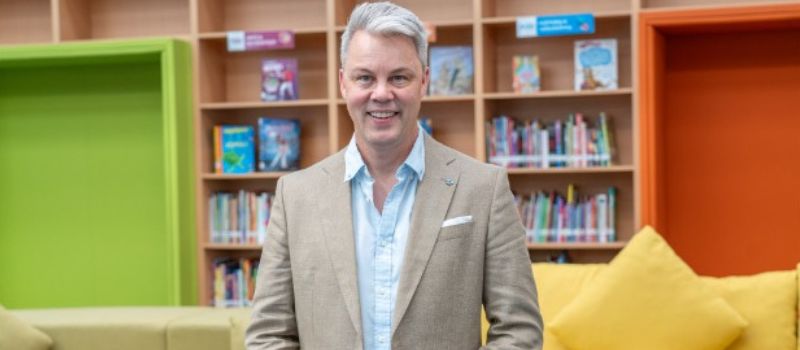
Edarabia had the opportunity to interview David Lees, Principal of Citizens School, Dubai, to explore how project-based learning, entrepreneurship, and purposeful technology use are shaping confident, future-ready learners. In this conversation, he shares how Citizens School focuses on design thinking, resilience, digital responsibility, and personalised learning pathways that empower learners to think critically, solve real-world problems, and adapt with confidence.
At Citizens, we look at AI through a very clear lens: how does it add value? Technology should support learning, not distract from it.
Our starting point is digital literacy. Before learners can meaningfully engage with artificial intelligence, they need to understand technology itself. This includes how information is created, how it can be interpreted, and how it should be used responsibly and critically.
AI is embedded most strongly within our core Project Based Learning programme. Through PBL, learners work on real world challenges using a design thinking framework. As part of that process, they use age-appropriate AI tools to research, analyse information, test ideas and refine their thinking.
At the same time, we are intentionally upskilling our mentors so they can confidently guide learners in using AI within this framework. The emphasis is always on understanding rather than shortcuts. Learners question outputs, interrogate information and reflect on how technology can support deeper learning.
For us, AI is not simply about introducing new tools. It is about ensuring technology adds genuine value to learners’ understanding and progress, while also supporting mentors and staff to enhance learning across Citizens.
In reality, very little has changed for us because smartphones have never been part of the school day at Citizens.
From the outset we set clear expectations with both learners and parents. We explain the reasoning behind our approach and how technology will be used purposefully within lessons when it adds value to learning.
Rather than unrestricted device use, technology is designed intentionally into learning experiences. When it is used, it supports understanding and progress rather than becoming a distraction.
Transparency with parents is also important. Through our Parent Advisory Group, we share insights each term about how technology and screen time are being used across Citizens. This helps families understand how digital tools support learning while maintaining balance.
A phone free environment reinforces something we care deeply about. Genuine connection. Breaktimes are active, conversations happen face to face, and learners remain present in the moment.
Strong foundations matter. In the early years and primary phase our focus is on developing thinking skills. Curiosity, logic, creativity and the ability to question information.
As learners grow older, AI becomes a guided tool rather than a shortcut. When older learners use generative AI tools, an important part of the process is asking a simple question: how did you get there?
It is not enough for a learner to produce a polished product or final output. They must understand the journey that led to it. We often work backwards with learners, unpacking the process step by step so they can understand the prompts, decisions and stages that led to the outcome. This ensures they are not simply using generative AI to improve performance or produce something quickly, but that they are using it as a tool that supports learning.
This approach aligns with international research highlighted in the OECD Digital Education Outlook, which warns that generative AI can create what it describes as a “mirage of false mastery”. Learners may produce high quality outputs that appear impressive, but without understanding the thinking that sits behind them.
For us, the priority is making thinking visible. Learners must understand the reasoning, questioning and design thinking stages behind the work they produce. When AI is used in this way, it becomes a powerful learning partner rather than a shortcut that replaces thinking.
Ultimately our goal is not just for learners to be capable users of AI, but for them to understand how to think alongside it.
If I had to identify three, they would be empathy, adaptability and critical thinking.
Empathy matters because the future will demand collaboration across cultures, perspectives and technologies. Adaptability is essential because the pace of change across industries is accelerating. Many of the jobs our learners will eventually enter do not yet exist. Critical thinking ensures that learners do not simply consume information but analyse it, question it and apply it responsibly.
At Citizens we are intentionally skills based because academic knowledge alone is no longer enough. Communication, resilience, risk taking, digital and financial literacy, and collaboration are capabilities that allow young people to thrive.
Our responsibility is not simply to prepare learners for examinations. It is to equip them with the mindset and skillset needed to navigate and shape an unpredictable future.
We focus on developing capabilities rather than directing learners toward specific professions.
Entrepreneurship is a core element of the Citizens model and runs alongside our Project Based Learning framework. Learners are regularly challenged to identify problems, design solutions and develop ideas that could work in the real world.
Through this process they develop an entrepreneurial mindset. They learn how to recognise opportunities, think creatively, collaborate with others and communicate their ideas clearly.
Careers will inevitably evolve, but the ability to adapt, think critically and approach challenges creatively will remain constant. Our goal is to equip learners with the mindset and skillset to navigate that uncertainty with confidence.
Education cannot be one size fits all because learners themselves are not.
At Citizens, learning is designed around the individual. We set personalised goals alongside academic expectations and place the learner at the centre of every experience.
Success therefore looks different for each learner. That belief sits at the heart of our approach. Education should adapt to the learner, not the other way around.
Resilience is embedded directly into the learning journey through our Project Based Learning model.
Learners bring together knowledge and understanding from across their subjects and apply it within design thinking challenges. Using the stages of the design thinking framework, they develop “How Might We” questions that challenge them to solve real world problems.
This process requires learners to test ideas, refine them and sometimes rethink their entire approach.
The structure of PBL creates a safe environment where learners can take risks, experiment and learn from setbacks. Failure becomes part of the innovation process rather than something to avoid.
Over time, learners develop the confidence to tackle complex challenges with creativity and resilience.
Our Citizens community is at the heart of everything we do. This includes our staff, learners and parents. We recognise that a strong culture must be a tangible and lived experience every day.
One of our five pillars is “Everyone Known and Known Well”. This applies not only to learners but also to staff and families. Our goal is to ensure every member of the community feels understood, supported and able to achieve their best.
We prioritise clear communication, regular check ins and feedback systems that genuinely listen. Staff, learners and parents all have opportunities to share honest feedback and leadership is committed to responding to it.
We operate a simple philosophy. You said, we did. Even when decisions may not align with every viewpoint, our community always understands why they were taken and when they will be reviewed.
Citizens is on an exciting and evolving journey. There is no fixed blueprint for the path we are taking, which means we must remain agile. Continuous feedback and open dialogue ensure the wellbeing of our community remains central to that journey.
Citizens is a fully inclusive and diverse community, welcoming learners from more than 75 nationalities.
Our approach to inclusion focuses on recognising the unique strengths and needs of every learner. Support begins with quality first teaching and personalised differentiation within the classroom.
Where additional support is required, our inclusion team works closely with mentors to develop Individual Education Plans and Inclusion Profiles tailored to each learner.
These plans ensure that support strategies, learning goals and progress monitoring are aligned with each learner’s needs, reinforcing our guiding principle that everyone should be known and supported as individuals.
Digital citizenship is embedded across the curriculum.
Learners explore issues such as privacy, authorship, bias and the long term implications of their online activity. They learn to think critically about technology and understand both its opportunities and its risks.
The focus is on helping young people make responsible and informed choices in a digital world that will increasingly shape their lives.
Parents are essential partners in the learning journey at Citizens.
One of the most exciting examples of this partnership is our Parent Co Mentoring Programme. Through this initiative, parents work alongside mentors to co plan elements of our Entrepreneurship curriculum, bringing their professional knowledge and expertise into the learning experience.
For example, a parent with experience in branding may collaborate with mentors to design and co deliver a session exploring how branding works in the real world.
This benefits everyone. Mentors gain industry insight, parents become more deeply connected to the learning process, and learners experience first hand how ideas and skills apply beyond the classroom.
It is a powerful way of bringing real world experience into learning while strengthening the sense of community across Citizens.
The pace of change in education is significant, so supporting mentors is essential.
We invest in professional learning, mentoring and collaborative planning so mentors feel confident navigating new approaches and technologies. Innovation should empower educators rather than overwhelm them.
When mentors feel supported and trusted, they are able to focus on what matters most. Creating meaningful learning experiences for every learner.
The future will be shaped by those who adapt to change with courage, curiosity and integrity.
Our responsibility as educators and adults is to empower young people with the mindset, skills and confidence to navigate that future. Not simply to enter it, but to shape it positively for the communities they will serve.
While a dedicated AI curriculum is currently present at Citizens School, our priority is on building digital literacy as a foundational skill for learners across age groups. We believe that for learners to truly benefit from AI, they must first understand how to use technology responsibly, safely, and effectively before engaging deeply with AI concepts. Our learners area always taught to comprehend information and not just consume it.
They engage in age-appropriate discussions and usage of AI tools, helping them understand how these technologies function in the real world and how to interact with them safely and ethically.
Any AI curriculum we introduce will be tested and adapted to the needs of our learners and aligned with UAE’s future focused national agenda and our skillset based model ensuring its relevant and meaningful.
The impact has always been positive because smartphones have never been part of the school day. We’ve consistently emphasised on richer one-to-one conversations, more active breaktimes, and stronger focus in lessons. A phone-free environment reinforces something we deeply believe in which is real connection. It allows us to be intentional about community, presence, and meaningful engagement every day.
Clear boundaries build strong foundations. Throughout the school – across primary and secondary we prioritise thinking skills — logic and creativity while inherentily building on their curiosity. For older students, AI becomes a guided tool for ethical exploration. We want them to graduate not just being technologically capable, but morally grounded and globally aware.
Arabic and Islamic Studies, are core to who we are as a school. While they are taught as individual subjects, they are also meaningfully woven into projects, conversations, and experiences. We place great importance on ensuring that everything taught at the school is lived, not just learned.
In a community as diverse as Citizens where we have over 72 nationalities under one roof, identity is both rooted and expansive. We honour the UAE’s heritage with pride, while preparing our learners to step confidently into a global future. We also extend this journey to our parent community through parent workshops and learning opportunities, strengthening the connection between school and home.
If I had to name only three skills I would say – empathy, adaptability, and critical thinking.
Empathy matters because the future will demand individuals who can collaborate across cultures, perspectives, and technologies. Adaptability is essential in a world where industries and roles are constantly evolving. The kids of today will be going into jobs that don’t exist today and futures that are unknown. Critical thinking ensures our learners don’t simply consume information — they analyse, question, and apply it responsibly.
Citizens School is intentionally skills-based because academic knowledge alone is no longer enough. Life skills — communication, resilience, risk taking, digital & financial literacy, collaboration — are what enable young people to thrive, not just succeed. Our role is not just to prepare children for exams, but to equip them with the capabilities to navigate and shape an unpredictable future and ready them for life.
We focus on developing capabilities rather than directing children toward fixed career paths. One of our core pillars is entrepreneurship — combined with project-based learning — which teaches learners how to learn, not just what to learn. Careers will inevitably evolve, but the ability to adapt, to think critically, and to approach challenges creatively is something that must remain constant. Our goal is to equip our learners with the mindset and skillset to navigate an ever-changing world with confidence.
Learning looks different for different people — there is no one-size-fits-all approach – we know and understand that. For us, learning is desgined around the learner, placing them at the heart of every experience, where we set individual goals alongside academic benchmarks. Success is defined uniquely for each learner — reflecting our belief that education should adapt to the learner and not the other way around.
Resilience is built into the learning journey so its habitual. Learners are challenged yet supported, and encouraged to reflect, knowing that mistakes aren’t failures — they’re opportunities to grow. We celebrate effort, not just outcomes, and learning never feels forced. We ensure that our learning environments are a safe space where trying, failing, and improving are all part of the process, resilience becomes a habit and learners gain the confidence to face challenges with curiosity and courage.
Regular check-in with staff – mentors and admin, wellbeing monitoring, and open dialogue.
Inclusion means providing personalised pathways that recognise each learner’s strengths. We focus on giving them the right tools, guidance, and encouragement so they can fully access the curriculum, grow in confidence, and make real progress. Inclusion isn’t just about being part of the class — it’s about helping every learner thrive.
Digital citizenship is part of the curriculum. Learners learn about privacy, authorship, bias, and the long-term effects of their online activity. They learn about technology – its pros, cons and efficient but effective use. The focus is on helping them make responsible, informed choices online.
Parents are no longer just observers — they are essential partners in our learners’ journeys. Education today is a shared responsibility, and we believe that learning becomes when families actively engage and what children learn in school is that extended to the home aswell. Through parent classes, co-mentoring opportunities, and participation in community initiatives, parents help shape the environment in which learners grow. This collaboration strengthens our school community, ensures that learning extends beyond the classroom, and models values of empathy, curiosity, and responsibility. We truly believe that we as a school, along with parents are in this together — building a strong, supportive ecosystem.
We provide ongoing professional training, mentoring, and opportunities to collaborate so mentors feel prepared and confident, not overwhelmed. Our goal is to make innovation practical and manageable, so it helps mentors do their best every day.
The future will be shaped by those who adapt to change, approach it with courage, curiosity, and integrity. As educators and adults, our responsibility is to empower children with the skills, mindset, and confidence to navigate change, make thoughtful decisions, and contribute positively to their communities.






 Twitter
Add a Comment
Please do not post:
Thank you once again for doing your part to keep Edarabia the most trusted education source.