


Sheikh Mohammed Bin Rashid Al Maktoum, Vice President and Prime Minister of the United Arab Emirates and ruler of Dubai, has set an ambitious and impressive agenda for Dubai and the UAE in terms of his 2021 Vision, and quite rightly, education sits at the centre of that vision. His ambition will (notice I don’t say ‘may’) result in Dubai Schools progressing to become the top 20 schools internationally in terms of international league tables centred around PISA and TIMMS assessments.
Clearly, the KHDA (Knowledge and Human Development Authority), the regulatory body for Dubai’s Private Schools has a good evidence to argue that annual inspection has led to transformational improvement in Dubai schools. Responsibility for ensuring that Sheikh Mohammed’s Vision becomes a reality in the private education sector in Dubai lies with the KHDA and the DSIB (Dubai School Inspection Bureau) Inspection Teams. As a result, the annual DSIB Inspection Supplement which sits alongside the UAE Inspection Framework established The National Agenda for UAE schools. This sets an ambitious improvement framework to focus schools on improving student outcomes in PISA and TIMMS Assessments. In addition, schools are challenged to play a key role in other relevant and related areas such as high-quality teacher professional development, improving Arabic Education and ensuring positive outcomes for Emirati students.
Schools respond to the annual inspection and The National Agenda with a focus on Mathematics, English (literacy), Science, Arabic, and other aspects of the UAE Agenda such as Islamic Education and Social Studies. Annual inspection evaluates both student attainment and student progress as well as a number of other performance standards. Schools use international tests to evidence student outcomes. In addition, schools are encouraged to be innovative with their curriculum to ensure that students in the UAE are what John Hattie would term ‘assessment capable learners’ in relation to being highly prepared to perform exceptionally well in the PISA and TIMMS assessments.
It would be unfair on KHDA to argue that the DSIB Inspections only focus schools on academic attainment to reach the goals set through the National Agenda for PISA and TIMMS. Schools are also set ambitious targets to deliver a Happiness Agenda which ensures a focus on pastoral care and student well-being. Two recent developments include the new Moral Education Programme and an annual survey on student well-being both of which add to the ‘Hearts & Minds’ Agenda focused on student happiness. Furthermore, schools have to demonstrate innovation and inclusion relevant to curriculum and outcomes for all students. All of this sets schools on an incredibly ambitious trajectory. I’m experienced enough now in the Dubai context to confidently say that the expectation of school improvement is like no other that I’ve experienced in a number of other Headships in various settings. Believe me, schools in Dubai are incredibly busy and highly productive places of learning!
Annual inspection has certainly also been justified in relation to a lot of new schools opening in Dubai. These schools are given three years to grow and improve with annual ‘support’ from KHDA. They then step into the annual inspection cycle. Clearly, there is a fundamental justification for inspection at that stage such that KHDA is in a strong position to allow DSIB to quality assure the standards and expectations in these new schools.
However, the question is perhaps not whether this transformation agenda leads to positive outcomes in terms of the country’s ambition to fast-track the UAE upwards in international league tables, clearly, it does help to achieve that goal. Rather, whether this agenda leads to longer-term school improvement. Research in the U.K. recently revealed that some schools placed in ‘special measures’ by Ofsted (UK Government Inspection Bureau) that then appointed what became known as ‘superheads’ in the media (experienced Headteachers with impressive records on transformational change in outstanding schools) could definitely be turned around quickly on a path of school improvement. However, if and when that Headteacher moved on, the research showed that some of these schools were unable to sustain longer-term improvement.
Michael Fullan, arguably one of the world’s leading educational writers would argue that this failure to maintain a sustained improvement agenda is because the change was superficial and based on student attainment and also therefore that schools are incredibly complex institutions. At one stage in his thinking, Fullan actually argued that sustained transformational change in schools, based on extensive research in Ontario in Canada, takes effective school leaders between five and seven years.
Similar to English Premier Division football managers, few education leaders would expect that timescale in terms of results in the context of the UAE!
In many ways, Kings’ Schools in Dubai sit perfectly placed to debate this issue. In Kings’ Dubai, we have the school with the longest ‘outstanding’ inspection grading in the UAE. In addition, we have two other incredible campus schools that are well on their way to successful inspection outcomes in terms of what we call our ‘journey to excellence’. All of the Kings’ Schools deliver on The National Agenda and contribute to ensuring that Dubai and the UAE are playing a key role in delivering Sheikh Mohammad’s Vision 2021.
Interestingly, last academic year KHDA innovatively introduced ‘The Abundance Project’ whereby schools deemed ‘Very Good’ and ‘Outstanding’ were given the opportunity to step out of the annual inspection cycle to pursue a year of innovative support for other schools with lesser outcomes for their students in Dubai. Nearly all of the ‘outstanding’ British Curriculum Schools, including Kings’ Dubai, took up this opportunity and enjoyed the benefits of working collaboratively with other schools. In Kings’ we have also engaged with John Hattie and his research on Visible Learning to use the time to work on transforming teaching & learning within our wider schools group. Teachers & leaders ‘working collaboratively’ in schools and across schools (one of Hattie’s highest effect sizes on positive student outcomes) was also extended successfully via The Abundance Project by The British Schools in Dubai (BSID) organisation. These premium UK Schools which include incredible schools such as JESS, DESC, Dubai College, Jumeirah College & Primary and Kings’ have worked together on a number of initiatives from Arabic Learning to Safeguarding. My argument here is that ‘transformational change and school improvement’ did not stop because annual inspection did not occur.
In the U.K. context, Ofsted and HMIe Inspection (which was never annual) has now taken a more ‘proportional’ approach with schools being targeted more specifically where improvement is known to be required, on the basis of knowledge of ‘big data’ such as national assessment outcomes or based on previous inspection grading. Over a more lengthy period, schools do still undergo periodic inspection but this can range from three to five years and in some parts of the UK even up to seven years. Interestingly this moves us into Fullan’s time period for a true transformation in the school system.
News from ADEK, the school regulatory body in Abu Dhabi, is that they will follow the UK model, also fast becoming the international model, and lessen the inspection expectation on schools previously graded at a high level. My informed guess is that a more timely and proportionate approach would be welcomed by most school leaders and teachers across the UAE. Were I to be even more radical and controversial I may even point out that Finland, one of the most successful countries in terms of education outcomes for students in relation to both student wellbeing and attainment in international league tables, actually has NO inspection agenda trusting schools with effective self-evaluation for improvement and a culture of complete trust in teacher professionalism. Perhaps a step too far?

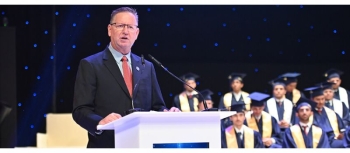
Alan Williamson is the Director of Education at King’s School, Dubai. He graduated from Glasgow University with an honours degree in History and Russian Language and has also attended the Harvard Graduate School of Education. His teaching career began in the Anderson School in the Shetland Islands and has covered schools across the United Kingdom, progressing from teaching and leading departments in Humanities and Languages to two Headships. This included heading up the first ever Scottish Future Trust School, an integrated community campus in Edinburgh from Foundation to Secondary level. He is particularly proud of work undertaken in the independent sector with Rugby School (in Warwickshire, England) through a partnership with the remarkable Arnold Scholarship Foundation. Alan became Principal of Kings’ School Al Barsha in January 2016. As well as being passionate about teaching and learning, he has been actively involved in school leadership related to Special Educational Needs.







 Twitter
Add a Comment
Please do not post:
Thank you once again for doing your part to keep Edarabia the most trusted education source.