


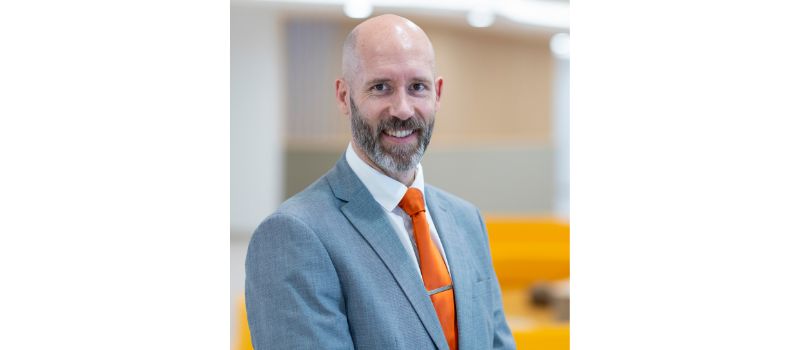
Edarabia had the opportunity to interview Lee Hole, Principal of Dubai British School Jumeira, to explore how the school is preparing students for a rapidly evolving world. In this insightful discussion, he shares how the school adopts a balanced, age-appropriate approach to technology, while prioritising human skills such as empathy, critical thinking, and adaptability. He also highlights the importance of resilience, strong school-family partnerships, inclusive education, and personalised learning in ensuring students develop into confident, well-rounded individuals ready to navigate future challenges.
This is not something that can happen overnight or be done irresponsibly. Education must tread carefully in this space, ensuring that children engage with AI in a graduated, age-appropriate way.
In Early Years, for example, we do not believe children should engage with technology beyond a very light touch in school. This is a formative period for developing social interaction, which is best achieved through play-based learning and exploration of the world around them.
At Dubai British School Jumeira, we believe that as children progress, they should be gradually exposed to AI -initially through adult modelling, then through guided and safeguarded use, and ultimately towards more independent application in the later stages of their education.
We have always been a phone-free school. Our secondary students store their phones in lockable pouches throughout the day, unlocking them only when they leave. As a result, we do not have comparative data to measure impact, as this approach has long been embedded in our culture.
We do not subscribe to the idea that AI proficiency alone defines competitiveness. Increasingly, industry leaders emphasise the importance of inherently human competencies – empathy, compassion, critical thinking, and sound judgement.
Knowledge and technical skills evolve rapidly. What matters most is that schools develop adaptable learners -young people with the capacity to learn, unlearn, and relearn. Our focus is on developing well-rounded individuals who can navigate change, rather than simply equipping them with specific tools.
The UAE is one of the most progressive and forward-thinking countries in the world, grounded in Islamic values and the Arabic language. We ensure these subjects are taught in a way that connects students to these foundational principles while making them meaningful and relevant within an international context.
Academic success remains essential, but the development of the whole person is equally critical. If distilled into three core skills:
Our role is to empower students to make informed decisions and that requires creating options. If students wait until the end of their journey to decide their direction, their choices are limited.
By encouraging exploration of passions and interests from an early age, we help students develop flexibility and openness. This approach allows them to pivot when necessary and adapt to changing circumstances.
Most schools in the UAE are moving beyond a one-size-fits-all approach. At DBSJ, a diverse curriculum, flexible teaching strategies, and strong co-curricular programmes allow students to explore their interests and strengths beyond the core curriculum, ensuring a more personalised and meaningful experience.
Resilience is built over time through culture, not quick fixes. It comes from creating an environment where it is safe to fail, make mistakes, and learn from them.
At DBSJ, we also work closely with families to reinforce this mindset. We encourage the idea of “embracing the struggle” and help students find the balance between challenge and overwhelm – where learning feels demanding but achievable.
Strong relationships are key. When students trust the adults around them, they are more likely to speak up when they are struggling.
Academic rigour alone is not enough – high-quality care must sit alongside it. Without that balance, even the strongest academic programmes will fall short.
We maintain high expectations for all students, including those with additional needs. Our inclusion team works closely with families, teachers, and students to ensure learning is both accessible and appropriately challenging.
Students of Determination also have personalised development targets, ensuring their experience is tailored, meaningful, and impactful.
Our computing curriculum develops both practical digital skills and the ethical understanding required to navigate the online world responsibly, helping students make informed and principled decisions about their digital presence.
The role of families has remained consistent. Strong partnerships between home and school continue to be a key factor in student success.
While students can succeed with varying levels of parental involvement, outcomes are significantly strengthened when families and schools work in close, positive collaboration.
At DBSJ, we recognise that education is an ever-evolving landscape. Teachers join our community with an understanding that continuous learning is part of the profession.
However, we are deliberate in how we introduce change. Rather than constant top-down implementation, we often rely on teacher-led exploration and working groups. This ensures that innovation is purposeful, sustainable, and supported by those who are most engaged with it.
Inspring is certainly a challenge but I would ask everyone that has a hand in the world of education to remember that our biggest asset in the rapidly digitized world is our humanity and we have a duty to develop this in our young people.











 Twitter
Add a Comment
Please do not post:
Thank you once again for doing your part to keep Edarabia the most trusted education source.