


Search Edarabia
Popular Searches: Schools | Universities | Courses | Jobs
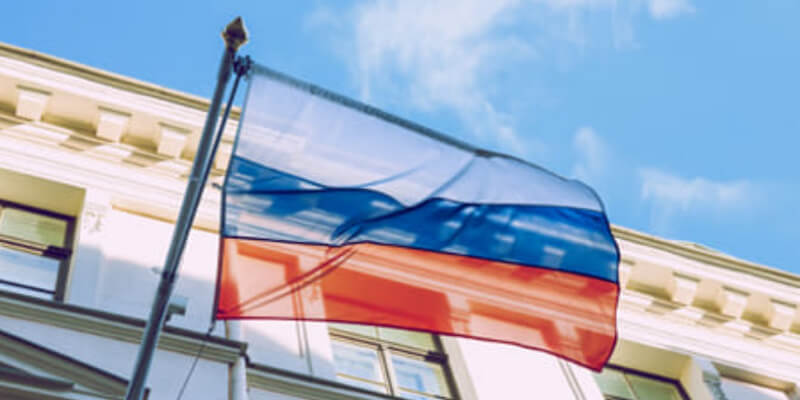
The flag of Russia consists of white, blue, and red horizontal stripes. It was adopted on December 11, 1993, after a constitutional crisis. Although simple in its design, the flag holds a deep meaning to Russians. Every August 22, the streets in the country are covered with the flag in celebration of their country.
Russia is the largest country in the world, with over 186 ethnic groups and extensive history. The first modern flag to be hoisted in the country was taken from Peter the Great, who had ambitious plans for the country. For starters, he wanted to transform it into a modern state with a powerful navy. Thus, he visited the Netherlands to learn more about shipbuilding techniques and concepts. In 1699, he adopted a flag for the Russian merchant ships. This flag consisted of the Dutch red-white-blue tricolor. The only difference between the Dutch flag and the Russian one is that the latter had the colors arranged in a different format of white-blue-red. For Russians, these colors had significant meaning. For instance, it is stated that the Red Shield of the Grand Municipality of Moscow were cloaked in blue and mounted on a white horse. Moreover, according to historical records, in 1667, a quartered flag of white and red with a blue cross was used on the first Russian warship known as Oryol.
The flag of Peter the 1st was considered unofficial. Thus it was used on the ships, but it was not recognized as the national flag. The official flag at the time was the Imperial Standard of Tsar, which consisted of a yellow background with the Tsar insignia at the center. The two flags were in use from 1700 to 1858. In 1858, a celebration flag was introduced. Nonetheless, the unofficial flag of Peter the 1st was the most popular.
Before the beginning of World War I, the flag of St Peter was modified by incorporating a golden yellow canton containing the imperial arms. This banner was a symbol of solidarity between the Russians and the ruling dynasty. From 1858 to 1917, a flag with the tri-colors black, yellow, and white, was introduced as the first official flag of the Russian empire by the decree of Alexander II. The colors resembled the Russian Coat of Arms. However, the traditional flag with white, blue, and red was preferred among the people and was still in use as the unofficial flag. In 1896, Nicholas II made the white-blue-red flag official, which remained in use until 1918.
The October Revolution of 1917 resulted in an end to the monarchy and the rise of the Soviet regime. The first flag of the Soviet system consisted of a red background with the term RSFSR on the upper left corner in Russian. This flag was later changed to feature a hammer and a sickle with a five-pointed star at the top and a blue vertical line on the left-hand side. This flag remained the state flag from 1954 to 1991. In 1923, a banner of the Soviet Union was adopted and initially featured the coat of arms of the Soviet Union at the center of a red background.
Moreover, the insignia consisted of two bands of wheat joined with a scarlet red ribbon. Between the sheaves of grain were a rising sun, the globe, and the soviet five-pointed star at the top. At the center of the globe was the sickle and the hammer. This flag was quickly replaced with a plain red flag consisting of the hammer and sickle, along with a five-pointed star on the upper left-hand corner.
When the Soviet Union was dissolved in 1991, its symbols were abandoned. The anti-communist ‘white movement’ adopted the white, blue, and red flag with slight modifications on the shade blue, which was lighter compared to the traditional flag. This flag became the official flag on August 21, 1991, four months after the dissolution of the Soviet Union. Thus, this banner became a symbol of a movement against communist ideology. It was widely used in the ‘August coup’ against the Soviet government.
In 1993, the flag underwent a proportion change, and the blue stripe became darker as it was in the traditional versions of the flag. Moreover, the flag had no insignia. However, the official flag of the President of the Russian Federation consists of a two-headed golden eagle insignia, that appears to be holding a scepter and a globe. At the center of the eagle is a shield depicting St. George slaying a dragon. This insignia is the Russian coat of arms and has been in use since the days of Peter the Great. This flag can be seen at the Kremlin, on presidential vehicles, and during any state agency.
Colors
Traditionally the colors of the flag had a different meaning from the modern version. For instance:
Another interpretation states that white represents God, blue represents the King, whereas red represents the people of Russia. Presently, there is no precise meaning as to what the colors represent. However, there is the general interpretation that white symbolizes frankness and nobility; blue represents virtues such as chastity and honesty, whereas red represents love, courage, and generosity.
Shape
The shape of the flag consists of a length to width ratio of 2:3. The initial 1:2 proportion was changed by a presidential decree on December 11, 1993. Only Soviet flags had the ratio 1:2. Therefore, when Soviet rule ended, the dimensions of the flag changed. Moreover, the horizontal bands are all of equal proportion.
Do you know any other interesting facts about the flag of Russia? Share your thoughts below.






 Twitter
Add a Comment
Please do not post:
Thank you once again for doing your part to keep Edarabia the most trusted education source.