


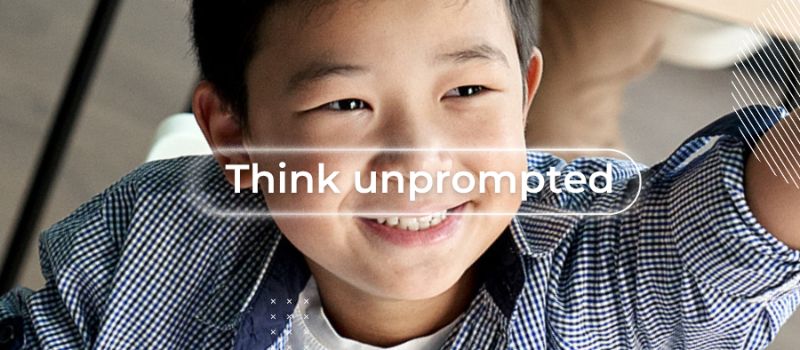
Your child asks ChatGPT for help with homework.
Seconds later, the answer appears — polished, confident, and convincing.
But will your child know whether it’s actually true?
Artificial intelligence is rapidly changing how children learn, research, and complete schoolwork. AI tools can summarise information, explain concepts, generate ideas, and even produce essays within seconds. Answers are becoming instant, accessible, and everywhere.
As these technologies become increasingly integrated into everyday life, educators and parents around the world are beginning to ask a deeper question:
If answers are now everywhere, how can schools ensure children still learn how to think for themselves?
At Nord Anglia Education schools, this question is shaping a growing focus on the human skills AI cannot replace — including critical thinking, curiosity, creativity, collaboration, resilience, and independent judgement.
Because while AI may help students access information faster, the future will increasingly reward those who know how to question information, interpret ideas thoughtfully, adapt to uncertainty, and make informed decisions with confidence.
Why critical thinking matters more than ever
For many years, education focused heavily on knowledge acquisition: learning information, memorising facts, and producing the “right answer.” But today’s world demands something more.
Children are now growing up surrounded by constant streams of information — from social media posts and online content to AI-generated answers and synthetic images. In this environment, knowing how to think critically matters more than simply knowing what to learn.
“Critical thinking is the means by which we make sense of the world,” says Dr Kate Erricker, Group Head of Education Research and Global Partnerships at Nord Anglia Education.
“With the rise of AI, it’s more important than ever. We can’t simply take the information we read or images we see at face value. Children need to understand how information is created, interpreted, and communicated.”
Global business leaders are recognising this shift as well.
When JPMorgan Chase CEO Jamie Dimon was asked what skill could best protect workers from being replaced by AI, his answer was direct: “Critical thinking.”
The World Economic Forum’s Future of Jobs Report 2025 similarly identifies analytical thinking, creativity, adaptability, and lifelong learning among the most important future skills employers are seeking.
In other words, success in the future workplace will depend not only on intelligence or access to information, but on judgement.
Teaching children how to think — not just what to learn
At Nord Anglia schools, helping students develop these skills is not treated as an “extra.” It is embedded into everyday learning experiences across subjects and age groups.
Supported by global research conducted in partnership with Boston College involving more than 12,000 students across Nord Anglia schools worldwide, educators explored a powerful question: what happens when students are explicitly taught how to reflect on their thinking, challenge assumptions, and analyse information more carefully?
The findings were significant.
Students demonstrated measurable growth in:
But beyond the numbers, teachers also observed students asking more thoughtful questions, becoming more independent learners, and showing greater confidence navigating uncertainty.
Because in an AI-driven world, children will not always need more information.
They will need stronger judgement.
What critical thinking looks like in the classroom
For many parents, phrases such as “critical thinking” or “metacognition” can sound abstract. In classrooms, however, these skills are developed through practical daily habits.
Across Nord Anglia schools, teachers use structured “thinking routines” that encourage students to pause, reflect, question assumptions, and explain their reasoning before rushing to conclusions.
One widely used routine is called “See, Think, Wonder.”
Rather than immediately deciding what something means, students are encouraged to ask:
Flossie Chua, Principal Investigator at Project Zero within Harvard University’s Graduate School of Education, has worked with Nord Anglia schools to introduce these simple but powerful thinking routines.
“‘See’ means slowing down your thinking,” Chua explains. “Spend time looking carefully and investigating what you notice.”
Even very young children can begin developing these habits.
Chua describes a teacher pointing to a tree missing its leaves and asking students a simple question: “Where did all the leaves go?” The children immediately began forming theories, asking questions, and testing ideas.
“These small moments matter,” she explains. “Their brains were working. They were trying to solve a puzzle and come up with an explanation.”
Critical thinking is also embedded across academic subjects.
In literature lessons, students may explore why characters made certain decisions and what alternative choices might have been possible. In science lessons, students may conduct experiments and then explain their findings through presentations or written reports, considering not only the facts, but also their audience, evidence, and communication.
These experiences help students learn not simply to consume knowledge, but to question, interpret, and communicate it thoughtfully.
Preparing children not just for exams — but for life
One of the greatest challenges children face today is the speed of information. AI tools generate answers instantly, online opinions spread rapidly, and digital platforms often reward fast reactions.
But thoughtful judgement often requires the opposite: slowing down.
At Nord Anglia schools, students are regularly encouraged to reflect before answering, explain their reasoning, reconsider assumptions, and respectfully challenge ideas.
Over time, they stop simply looking for reassurance that they are “right,” and instead begin asking:
That shift is powerful.
Because they are no longer simply waiting for answers.
They are learning how to make decisions.
Technology will continue to evolve, and AI will continue to reshape education and the future workplace. But some things remain fundamentally human:
These are the skills that help children thrive not only in school, but throughout life.
At Nord Anglia Education, we believe education should not simply prepare children to find answers faster. It should prepare them to think independently, act with confidence, and shape the future with curiosity, humanity, and purpose.
Because in the age of AI, success will not belong only to those who know the answers.
It will belong to those who know how to think.
Learn more about Nord Anglia Education schools in China










 Twitter
Add a Comment
Please do not post:
Thank you once again for doing your part to keep Edarabia the most trusted education source.