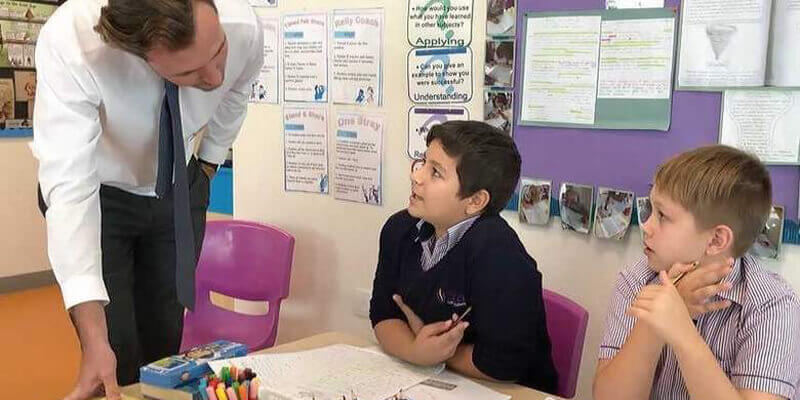
Dubai, UAE: About two and half years ago, six Syrian children in the UAE couldn’t spell their own names in English. They struggled to communicate and lacked confidence – all a byproduct of living through a war that has torn their country apart and taken the lives of many of their relatives and friends.
However, what they have accomplished since then they first moved to the UAE in 2016, should be an inspiring story for many. Nearly fluent in English, a large group of friends, a healthy confidence and big smiles – the Syrian children from Al Mousa and Ibrahim family are paving their way to success, thanks to the Safa British School and Safa Community School, which are now providing, not six, but seven children with free education until graduation.
Khaleej Times has previously documented their tragic stories of escaping war in Syria, their struggles of finding a place in the UAE’s education system and how they were offered free education by the Safa schools. Now, some of the Syrian children from the two families have spoken to Khaleej Times on their astonishing progress.
“I remember how I didn’t want to speak with anyone outside of my home because I didn’t know any English. It was really difficult for me,” said Mohammed Yaser Al Mousa, who is now in Grade 9 and dreams of becoming an engineer one day. “Now, I’m confident in speaking. The teachers at my school have changed our lives. If we were still in Syria, I’m not sure if I would still be alive.”
Yaser’s father, Ali Al Mousa, revealed that he was afraid that if his children had stayed in Syria, they would have been forcefully recruited by Daesh. “Escaping to the UAE saved their lives,” he said.
Ali has four children that attend the Safa Community School, including his eldest son Mohammed Azhari, Mohammed Yaser, Mohammed Noor and his daughter Lilas.
Mohammed Noor, 13, has become a ‘leader’ at his school due to his leadership skills and progress in different subjects.
“It’s not something I imagined would happen to us. Just a few years ago, our main goal every day was to stay alive and keep breathing. Now, I feel like I can choose any life and career path I want because I have access to a great education and so do my brothers and sister,” Noor said.
Hassan Ibrahim, a Syrian manager at a construction company in the UAE, has three children that attend the Safa British School, including Amal, Hassan and Mohammed.
Amal has become an exceptional student at the school. When she first joined, she would often require help from other peers in the English language, now, her friends ask her for help.
“I love coming to school. I’m very good at swimming and English class. I enjoy reading and writing and I’m also doing well in Maths. I would like to thank all of my teachers for helping me reach where I am today,” Amal said, who will be advancing to the sixth grade next year at the Safa Community School.
Amal’s youngest brother, Mohammed, joined the school this academic year in FS1. The school has offered him free education until graduation as well. Amal has another brother, 13-year-old Ibrahim, who lives in a refugee camp in Germany. Once he arrives in the UAE, the school has also promised him access to education. The dreams, hopes and aspirations of these seven children have been mended by the efforts of the Safa schools.
Unfortunately, there are several other Syrian families in the UAE who are struggling to find a place in the education system as charity schools are overcrowded. The Safa schools are a great example of how schools can help those in need – the progress of the seven Syrian children is proof that schools can change students’ lives for the better.
The Safa schools have been teaching the Syrian students for less than two years, yet, the pupils are nearly fluent in English – what is their secret?
The teachers at the Safa British School and Safa Community School have provided the students with several one-to-one support in various subjects, including English, since the children first started at the school in September 2016.
Although, some of the children do not require one-on-one lessons anymore due to fast progression and are fully immersed in the regular class with the rest of their peers.
“The children here at Safa Schools have a range of opportunities and that’s really important for us. However, what makes our schools are children like Amal, Hassan and Mohammed. They bring a different dynamics to our school. They came in with zero English, they have experienced items in the world that maybe other children in the world haven’t, and that really shaped their character,” Zara Harrington, principal at the Safa British School, said.
“For us, we feel really privileged they had chosen Safa British School to attend. They come in with a big smile on their face. They’re the first children to be here in the morning. They sit and greet everybody with a massive smile. The warmth they project, you can’t help but feel so grateful they’re here. They have gone from not being able to communicate in English, to be able to stand in front of their class, their peers, assemblies. The growth in them has been a phenomenon, their friendships have grown.
“The main moments for me is when Amal stood at one of our assemblies at about six months after she had joined the school. She read an extract of a poem that she had written in fluent English. She spoke as if she had been an English language learner her entire life. She continues that in every part of her learning.”
Leanne Fridd, the head teacher of primary at the Safa Community School, said the progress of Ali Al Mousa’s children has been astounding, especially of his young daughter, Lilas.
“Lilas was in the foundation when she first joined us and now she has moved into grade one. When she first came to us, she knew no English as Arabic was obviously her mother tongue language. So, for her, it was quite an adjustment. But if anyone knows the foundation stage, you’re surrounded by plays and your peers. She no longer requires one to one support for language comprehension or language understanding. She has fully immersed in a mainstream classroom,” she said.
“Her English in terms of how she speaks to people, her confidence around the school, her reading is where it should be at the age of a year one child. Her science, mathematics – she’s made fantastic progress, especially for a child that came to us 18 months ago with no English whatsoever.”
(Saira Tannir, English Teacher at Safa Community School, Dubai)
The root of education is removing barriers to learning. It is a minimal investment for a fundamental difference. One such barrier is language.
Students whose native language is not English may face this barrier in an English-based school, such as ours, until and unless this barrier is successfully eliminated. So, the impact of a weakness in the language can be overwhelming and extend to other subjects such as Maths or Sciences, unless the ‘core’ issue is addressed.
Our experience is that removing the barriers is a multi-track approach; It is a combination of intense intervention class for English, as well as simultaneous heavy support in other academic subjects.
By intense intervention, we refer to the one-to-one tuition of the language to the student, using a lot of pictures, gestures, and a bit of humour thrown in for good measure, to maximise the comfort of the student with the new language. A small part of information needs to be repeated often. Repetition is the key ingredient in binding the learning of a new language together. Reading books with minimal text to start with and plenty of pictures is also essential. The emphasis is on building up strong communicative skills, possibly ahead of grammar. We believe that once command of the language is built up, grammar will naturally and easily follow.
In parallel to the intense intervention, we encourage the attendance of the student of some other academic subjects which are given in English, using a buddy system- another student whose native language is the same as our student, to allow some element of ‘cheating’ where the buddy provides the vocabulary safety net to the student if and when he/she is struggling, while leaving the student in an English language environment. Hopefully, this allows the application of what has been gained in intense intervention.
In language learning, ‘slow and steady’ always wins the race. Cramming simply does not work.
During childhood, knowledge is absorbed like a sponge – including languages. Children get native language speaker-like proficiency quickly and easily, once they are comfortable with the ‘environment’. Motivation to learning a language comes from making a student comfortable with making mistakes in the language with the teacher. If pupils are well supported and self-motivated this is value added and can be phenomenal. Parents have an integral role too in this partnership- Another key to success is the practice of what is taught in school for 20 – 30 minutes daily at home.
© Khaleej Times









 Twitter