


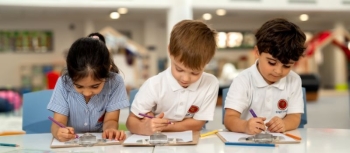
Teaching and learning during the Foundation stage is more child-centric and play-based. As we all know, children go through a sensitive period in which they are inquisitive to explore the environment through their senses. To support this, we have designed a specific activity room, external play area, as well as rich and interactive classrooms.
Being a trained Montessori teacher, I truly believe in Montessori teaching during the Foundation stage. The Montessori Method of Education is based on self-directed activities, hands on learning and collaborative play. Children work in groups and individually discover and explore their knowledge of the world to develop their maximum potential.
The teacher does not solely run the classroom. Students guide the activities they do throughout the day. This encourages children to share and work cooperatively to explore various areas. The environment teaches children self-discipline and it refines important skills such as concentration, self-control, and motivation. Children are encouraged and motivated to be independent learners.
The Montessori curriculum includes Practical Life, Sensorial, Maths, Language, Geography, Science, Art and Music. It is designed to meet the seven areas of Early Years. Practical Life materials such dressing frame, pouring, spooning, transferring with tongs etc. help them to learn the life skills and also hand-eye coordination. Sensorial materials such as Knobbed cylinder, sound boxes, smell bottles etc. enable their senses to be explored to the fullest. In Language and Maths, they learn letters and numbers well by tracing on sandpaper letters or numbers. Tracing the letter or number becomes the part of the child’s muscle memory and indirectly prepares him for reading and writing. Maths materials such as spindle box, Number Rods, Addition board etc. help to teach the Maths concepts in concrete form rather than abstract form. Thus we see all the materials are unique in their learning. They teach the children control of error and purposeful activities using movement and exploration. Each material isolates the concept and skill. They develop their fine motor skills essential for writing.
Montessori education offers children opportunities to develop their potential as they step out into the world as engaged, competent, responsible, and respectful citizens with an understanding and appreciation that learning is for life.
“The goal of early childhood education should be to activate the child’s own natural desire to learn.” Maria Montessori.”

Meeta Asarpota is a caring and loving teacher, FS1 coordinator, Montessori head and Maths coordinator at Newlands School, Al Warqa. She believes in educating children through hands-on activities that refine their concentration, creativity, self-esteem, and discipline.








 Twitter
Add a Comment
Please do not post:
Thank you once again for doing your part to keep Edarabia the most trusted education source.