


According to the Digital Transformation Playbook by David Rogers, business disruption happens when an existing industry faces a challenge that offers far greater value to the customer in a way that existing firms cannot compete with.
An Emirati CEO recently said that he constantly challenges his team and his board urging them to listen to the junior staff. As much as we are leaders, we might be old-school, he says; let the young minds have a voice for they see the world through new lenses.
With these statements in mind and the notion that 85% of the jobs that will exist in 2030 have yet to be invented, (according to joint research by the Institute for the Future and Dell Technologies), schools and education systems worldwide need to become far more flexible, change-oriented and provide students with a more authentic learning experience to ensure that they are educated for a future, which is not yesterday’s news.
Substantial research informs that today’s graduates will have to create their own jobs and schools should, therefore, prepare students to embrace whatever opportunities await by teaching them skills that go beyond academics, mastering the latest technology to provide opportunities to become skilled transformational thinkers who can excel in any and all endeavors.
Entrepreneurial skills are not fostered in a classical school system based on rote-learning. When students do not see how their learning is connected to the world outside the classroom they often become disengaged and lose their curiosity. Context-based learning can respond to market disruption and drive authentic student inquiry through challenging guiding questions.
Flexibility, perseverance, resilience, and resourcefulness, are essential to success in the competitive marketplace and in life.
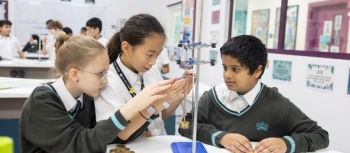
The IB, International Baccalaureate curriculum framework, recognizes the importance of ensuring that students make authentic connections and thus foster an entrepreneurial mindset through inquiry, design, and service, sparking initiative, collaboration, decision-making and action-taking. The IB curriculum, which emphasizes student-driven inquiry, encourages students to work on projects of their own imagining, take risks, and to become problem-solvers through design thinking and hands-on learning pulling in elements of graphic design, architecture, engineering, filmmaking, programming, robotics, and more.
The introduction of learning technology and new subject areas are in themselves not sufficient to make learning authentic. Authentic learning occurs when students learn through research, by doing, testing and failing. A holistic approach to relevant lifelong learning entails for example that students intuitively understand what to do, both practically and theoretically, in any given situation, also when faced with pressure and stress. Students must learn to use wisdom and sound judgment when assessing any situation.
More than ten years ago, Sir Ken Robinson, gave the most popular TEDTalk of all times; Schools Kill Creativity. His message is that creativity is as important in education as literacy, and we should treat it with the same status. Children’s frontal cortex is underdeveloped but they have more neurons than adults, which make them so creative. Some schools, such as Dwight, take seriously that we have an opportunity to ensure that students do not grow out of their creativity. Programs like Spark Tank, which at Dwight is an incubator designed to teach entrepreneurial, innovation, and leadership skills, go about education differently and take the holistic idea of educating the whole child to a different level. By fostering a mindset of creativity, imagination, and innovation, students are provided with an arena where they can take advantage of opportunities to explore what they are learning through authentic action, and thus ignite their spark of genius, so that they can face this future and truly make something of it.
Dwight School Dubai believes in students as Innovators – Creators – and Entrepreneurs and trusts that the next ‘big ideas’ for sustainable human development will come from the under 18 sector.
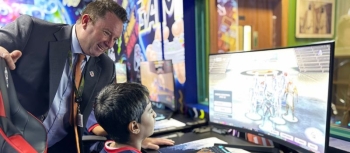
Spark Tank, initiated by our school in New York in 2016, and now implemented in Dubai is Dwight’s incubator designed to nurture student innovation, entrepreneurship, and leadership skills beyond the classroom. Beginning in Pre-School, students can participate in the Spark Tank Program to develop their ideas for new businesses, non-profits, or products.
Dwight is one of the few international K-12 IB schools to offer this incubator experience. Spark Tank provides students with real-life experience and essential skills beyond academics and theory, so they can spark their curiosity, nurture their creativity and pursue their dreams now rather than at some uncertain time in the future.

Janecke Aarnaes brings to Dubai over 22 years of teaching experience. Prior to joining Dwight School Dubai as Head of School, Janecke held the position as Head of School at Oslo International School (OIS) in Norway, a cutting-edge private K-12 co-ed IB World School. Having started as a foreign language teacher, Janecke has worked within the private educational sector, within both national and international schools in Norway and Belgium.
Janecke has held progressively senior roles in the education sector, including seven years as Head of School at Sonans, Oslo, a strategic project role as Business Development Manager at the Scandinavian School of Brussels (SSB), where she also served on the Board of Governors. She was also an Officer to the College of the EFTA Surveillance Authority in Belgium, a judicial intergovernmental institution in Brussels tasked with monitoring implementation of EU legislation. Her experience also includes stints with private educational start-ups, such as the Sonans Privatgymnas, a Norwegian upper secondary school for adults in Drammen, where she was founding Principal, and for performing a demerger at SSB that resulted in the founding of the Norwegian School of Brussels (DNSB).
Janecke is also a respected board member of the ECIS, the Educational Collaborative for International Schools. She holds a postgraduate diploma in Leading Innovation and Change from York St. John’s University in the United Kingdom and a bachelor’s degree in Sociology and Anthropology, Political Geography, and French from the University of Oslo in Norway. Furthermore, she has studied international relations in Paris and speaks eight languages including English, French, Norwegian, Swedish, Danish, Spanish, Italian, and German.
Please do not post:
Thank you once again for doing your part to keep Edarabia the most trusted education source.







 Twitter
with out Education woman's being is empty
By Abrham Tesema Nigussie (Mar, 2019) |