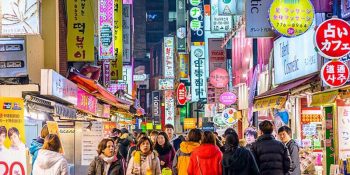
With a population of 51,966,948 (2023 est.), South Korea is a sovereign state in East Asia, constituting the southern part of the Korean Peninsula. South Koreans lead a distinctive urban lifestyle, as half of them live in high-rises. It is the world's sixth leading global city with the fourth largest economy and seventh most sustainable city in the world.
In South Korea, higher education is important and is considered one of the foundations of life in South Korea. It is a cultural status and a necessary means to improve the socioeconomic status of one person in Korea.
South Korea has invested heavily in the fields of research and education. It’s the third largest economy in Asia and the 13th largest in the world. It has more than 85,000 international students hailing from around 170 countries. By 2020, South Korea aims to get 200,000 international student enrollees.
Being one of the rising Asian economies alongside Hong Kong, Singapore, and Taiwan, South Korea is one of the best places to study abroad with its modern lifestyle and amazing climate, international students flock universities in South Korea for a good education.
Primary and Middle School (Grades 1 – 9) are compulsory education in South Korea. The central administration in South Korea which oversees education is the Ministry of Education, Science and Technology.
Schools in South Korea start the academic year during March and ends in the middle of July (1st semester) and starts again in August, ending in mid-February (2nd semester). The school year is divided into two semesters.
On average, Korean grade-schoolers spend 220 days a year in school. The average Korean child spends 13 hours a day in school (with supplementary classes). Some schools do not have a uniform while others schools require one.
Stages of Education in South Korea
| Stage/Level | Description |
|---|---|
| Pre-school | This stage is optional for ages 3 to 6 years old. Parents must shoulder the fees for their child’s education. For low- income families, the government provides support. |
| Chodeung Haggyo(Primary School) | This stage is compulsory from age 6 - 12 for all children in South Korea. Some schools will accept children from age 5. Primary education is free in South Korea. |
| Jung Haggyo(Middle School) | This stage of education is compulsory for children aged 12 – 15 years old and is free of charge. |
| Godeung Haggyo(Secondary School) | This stage of education is not compulsory and starts from age 15 to 18 years old. They can attend specialist or vocational schools. Parents will have to shoulder their child’s education. |
| University | Obtaining university education is a cultural and social status in South Korea. |
Pre-school is not compulsory in South Korea. But if you want your child to attend nurseries or preschool, you can do so. There are government-run and private nurseries. These are good options to prepare your child for primary school.
Primary School (Chodeung Haggyo)
Also called Chodeung Haggyo, primary school starts from age of five or six. This depends on whether a school can offer school spaces or if the child can cope up with first grade early. Primary school is compulsory and lasts for 6 years. It covers basic skills, languages, and physical education classes.
Before attending primary school, a child must undergo vaccinations from medical centres. Teachers must check the medical record online and make sure this is done. Schools will charge afterschool and before school activities. Low income families will receive support from the South Korean government.
Middle School (Jung Haggyo)
Once students reach 12 years old, they need to go to middle school. This will usually last for 3 years. It is free of charge in South Korea which covers a combination of mandatory and elective subjects.
Some of these subjects are math, Korean and English languages, social studies, science, art and PE. Korean students will also learn about moral education.
Secondary School (Godeung Haggyo)
Secondary school options in South Korea are broad. Students can choose to specialize in a school with their chosen field – arts, music, etc. Education is paid for by parents and the government provides for low-income families
This stage is the preparation for university. They need to take and pass the College Scholastic Ability Test (CSAT) in order to get into a university. Students should have good grades during this stage.
Below is a comprehensive list of all universities in South Korea (Andong, Ansan, Anseong, Anyang, Asan, Boryeong, Bucheon, Busan, Changwon, Cheonan, Cheongju, Chuncheon, Chungju, Daegu, Daejeon, Dangjin, Dongducheon, Donghae, Gangneung, Geoje, Gimcheon, Gimhae, Gimje, Gimpo, Gongju, Goyang, Gumi, Gunpo, Gunsan, Guri, Gwacheon, Gwangju, Gwangmyeong, Gwangyang, Gyeongju, Gyeongsan, Gyeryong, Hanam, Hwaseong, Icheon, Iksan, Incheon, Jecheon, Jeju, Jeongeup, Jeonju, Miryang, Mokpo, Mungyeong, Naju, Namwon, Namyangju, Nonsan, Osan, Paju, Pocheon, Pohang, Pyeongtaek, Sacheon, Samcheok, Sangju, Sejong, Seogwipo, Seongnam, Seosan, Seoul, Siheung, Sokcho, Suncheon, Suwon, Taebaek, Tongyeong, Uijeongbu, Uiwang, Ulsan, Wonju, Yangju, Yangsan, Yeoju, Yeongcheon, Yeongju, Yeosu, Yongin). Edarabia strives to offer the latest updates, helping you find the best university in South Korea with information on tuition fees, accreditation details, videos, photos, location map, community reviews and ratings.
Edarabia showcases all universities and colleges in South korea which can be filtered by courses and tuition fees. International students looking to get a degree in South korea can choose from a diverse range of programs and diplomas and obtain their Bachelor’s, Master’s, PhDs (or MBAs) from some of the top-rated institutions. Some universities also offer online courses through which students can apply for distance learning and get an online degree in certain fields.
Students who require financial aid can apply for scholarships in order to study higher education at a lower cost. Student visas and accommodation are also provided to students at many universities. There are study abroad and exchange programs offered in order to promote language development skills while giving students the opportunity to interact with other cultures around the world. Additionally, each university/college has ratings based on student reviews and are ranked below accordingly.
For more details, please click here







 Twitter