


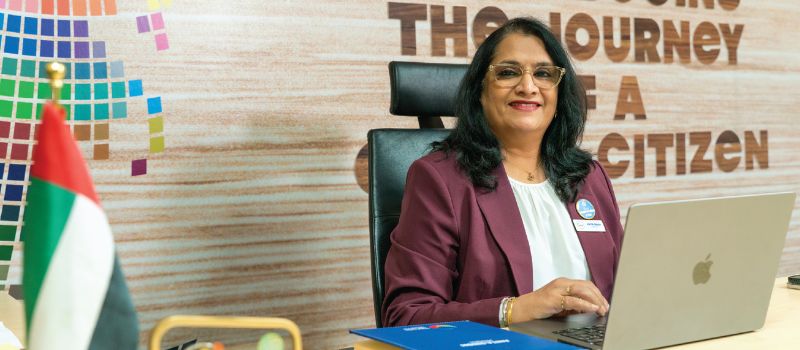
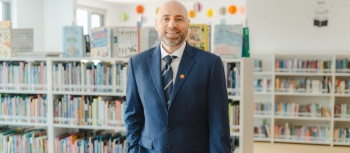
Edarabia had the opportunity to interview Anita Singh, Principal of Global Indian International School Dubai, to discuss the school’s academic vision, strategies for student engagement, and commitment to holistic development.
A: Ever since COVID, the disruption has led to a transformation in the educational landscape.
GIIS Dubai has been teaching AI ever since CBSE introduced it as a skill subject. The UAE’s decision to introduce Artificial Intelligence as a subject from Kindergarten to Grade 12 is a major shift in education. It also aligns with the CBSE initiative to equip students with an in-depth understanding of AI concepts, linking it with real-world applications, data and ethical usage. At our school, AI is now included as a skill subject that equips students with digital literacy, ethics, and problem-solving skills.
The focus is on ethics and the responsible use of AI. Students are not only learning how AI works at GIIS Dubai but also questioning how it should be used responsibly in society. This ensures they are active learners and not passive consumers of technology.
A: The ban on smartphones in schools by the MoE is a welcome initiative, and the impact is transformative for school culture. With devices away, student interaction is improved and a significant difference is noticed in student attention span with reduced distraction.
A: We need to remember technology must support learning, not replace thinking. For the younger students, we focus on building foundational thinking skills like analysis and creativity without leaning on generative tools.
For senior graders, AI is utilized in a guided learning environment where they learn to use AI responsibly, verifying information, acknowledging sources, and understanding limitations such as algorithmic bias.
It is exciting to see that students are not just learning how AI works; they are learning how to use it responsibly and thoughtfully in society. That balance is critical for the future. Students must not only be AI-literate but also AI-wise.
A: We are following the stipulated minutes as mandated by the Ministry. The new rule for teaching Arabic and Islamic Studies in KG is accommodated with the presence of an Arabic teacher in other lessons, along with the subject teacher. MSCS is already in place and is integrated across subjects. UAE is a melting pot of cultures, and in this multicultural learning environment, national subjects are taught not merely as a curriculum but as an experiential learning of culture, identity, and values.
Storytelling and cultural activities are used to teach the Arabic language learning through communication opportunities. The focus is on universal values such as compassion, responsibility, and ethical leadership in Islamic Studies. This allows students from diverse backgrounds to appreciate and connect with these subjects.
A: As a School we ensure students are equipped not only with knowledge but with the capacity and skills to be responsible global citizens. The three non-negotiable skills that are key for success in future are Critical thinking with creativity, Adaptability with agility and ethical leadership. In today’s world, there is no dearth of information. Students must be equipped to evaluate information, challenge assumptions, and solve complex problems innovatively. Change is the only constant these days, so their ability to be comfortable with change and the confidence to learn new skills throughout life quickly will be an added skill, along with a strong moral compass with integrity as the guiding force, so that they take responsible decisions in a global world
A: At GIIS Dubai, we believe in focusing on developing adaptable learners rather than preparing students for a single career path. Career guidance and counselling is one of our unique features where a dedicated school counsellor emphasises multiple skills development rather than job titles. Instead of asking students, “What job do you want?” We ask them, “What problems do you want to solve?”
A growth mindset approach encourages curiosity, innovation, and purpose; qualities that matter far more than a fixed career title. Students are provided opportunities for internships, competitions and collaborative projects that give firsthand experience of real-world complexity.
A: Every student is unique with their individual strengths and learning styles. It is the school’s responsibility to provide them with multiple pathways to success. GIIS Dubai takes pride in providing successful pathways through personalised learning plans, ECAs and CCA opportunities, and student-led projects. Whether a student excels in science, the arts, leadership, or community service, their journey is celebrated and supported.
Education should not be about fitting students into a mould; it should be about helping them find their innate potential and what they can contribute.
A: Some skills are learnt through experience and resilience is one such skill which can be developed through experience and not through instruction. Sports plays a key role in developing this skill of learning to bounce back after a defeat or learning from failing in achieving the outcome in a given project. Reflection practices help them understand that setbacks are part of growth. Through these small steps, students learn that life is not always a bed of roses, but with them come the thorns and it is not the end but an opportunity to ideate and innovate.
A: A healthy mind and a healthy body is a formula for success. Student well-being is central to sustainable learning. We have an inclusive support system which ensures regular well-being check-ins, mentoring programs, and accessible counselling services.
Teacher capacity building is a priority to help them recognise early signs of stress, while well-being surveys and transparency allow students to express concerns proactively. We create an environment where students feel supported, heard, and valued. This proactive approach ensures that success is measured not only by grades but by confidence, balance, and emotional resilience.
A: The UAE is a regional leader in inclusive education, particularly through its commitment to supporting Students of Determination.
We are an inclusive school. Inclusion at GIIS evolves beyond access toward achievement and empowerment. Students of Determination benefit from individualised learning plans, specialised support teams, and adaptive technologies. There is no room for bullying at our school. Students respect and celebrate diversity of ability, creating a school culture which is conducive for learning. Our focus is to ensure that every student has the opportunity to excel and contribute meaningfully to the school community.
A: The students of today are extremely exposed to too much technology and are digitally connected and this is unlike anything we have seen before. Digital citizenship becomes imperative to enable them to differentiate fake from real, respect privacy, maintain online ethics, responsible communication etc. Webinars, Leadership Lecture series and talk shows are conducted for them by eminent professionals from various fields to help them understand the importance of their digital footprints which acts as a portfolio highlighting their values, achievements and who they are as a person.
A: It takes a village to educate a child. Education today is a partnership with parents as collaborators in students’ learning journey. Parental engagement through cultural initiatives, wellbeing programs, or community engagement during moments such as Ramadan strengthen parent school partnership and reinforces shared values. A strong school ecosystem emerges when educators, parents, and students share responsibility for growth and learning.
A: You cannot expect teachers to teach skills with which they are not equipped with. Capacity building through continuous training is mandatory. Non-Instructional working days are scheduled with need-based CPDs to ensure teachers are adept at using technology to enhance student learning experiences. Staff well-being is also given equal importance through celebrating their achievements or initiatives etc.
When teachers feel empowered and supported, they become the most powerful drivers of meaningful change.
The education we provide today will shape tomorrow’s world. At GIIS Dubai, we believe education is not about preparing students for the future; it is about empowering them to shape it
The one message I would love to leave for our community is: Students are growing up in a world that is changing rapidly and the holistic education we provide for their overall development will remain timeless.
As schools, we must nurture both character and competence to empower students as future leaders capable of building a better world.
The future does not belong to those who wait for it; it belongs to those who create and lead it with courage, curiosity, and compassion.




 Twitter
Add a Comment
Please do not post:
Thank you once again for doing your part to keep Edarabia the most trusted education source.