


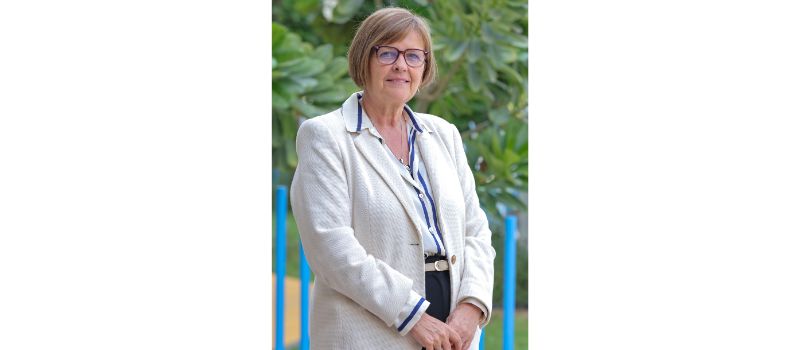
Edarabia had the opportunity to interview Jayne Needham, Principal of Emirates International School – Jumeirah, to discuss the school’s academic priorities, strategies for student engagement, and commitment to well-being. Ms. Needham shared insights into EISJ’s approach to innovative teaching, holistic education, and creating an inclusive environment where every student can thrive.
At Emirates International School, Jumeirah, we are engineering the shift from passive consumption to active creation and integration of AI. While we once used AI to summarise or look for quick answers, we now treat AI as a literacy. From primary school onwards, students are asked to demonstrate how they research, how they check the veracity of their research and to show how they have brought this together into an outcome. As IB learners, we are developing the IB Learner profile and encouraging students to be ‘Thinkers’, ‘Inquirers’ and, most importantly with AI, ‘Principled’.
At Emirates International School – Jumeirah (EISJ), the smartphone ban was implemented from the start of this academic year. The decision was aligned with our commitment to maintaining a focused learning environment consistent with the values of an IB education.
Since its introduction, we have seen students become more engaged both in their learning and in their interactions with one another. Breaktimes are noticeably more active and social, with students spending more time in conversation, sports and shared activities.
Technology remains an important part of the learning process at EISJ, but it is used purposefully within structured classroom environments. Overall, the change has helped reinforce a school culture where presence, collaboration and meaningful engagement are prioritized.
With a range of students from ages 3 to 18 years, we aim for scaffolded autonomy. For students under 13, we focus on strengthening the core cognitive muscles of independent writing and critical thinking. For our older students, we treat GenAI as a partner, using it for brainstorming and redrafting, but students must submit ethics and iteration logs that track how they verified AI’s claims and corrected its biases.
At EIS-J, we view Arabic, Islamic Studies, and National Identity subjects not as isolated silos, but as the cultural heartbeat of the school. We integrate these into project-based and interdisciplinary learning. For example, a science project on sustainability might have incorporated the UAE’s Year of Sustainability initiatives, ensuring that even our most international students feel a deep, authentic connection to their host country’s vision.
Certain skills are becoming even more important for our students as they graduate. Metacognition is the ability to understand how they learn so they can develop to become lifelong learners. Emotional Intelligence (EQ), which is the uniquely human ability to lead with empathy in an automated world, becomes even more critical. Specifically modelling and encouraging a critical scepticism and developing the skill to discern truth in an era of deepfakes and algorithmic bias will give our students essential tools in the workplace and beyond.
At EIS-J, we work closely with students and parents to focus on transferable competencies rather than preferred job titles. Instead of saying ‘I want to be a doctor,’ we encourage students to say ‘I am interested in biological problem-solving.’ By focusing on the ‘problem’ they want to solve rather than the ‘title’ they want to hold, they remain agile when the job market shifts and are developing transferable skills.
As an IB Continuum School we embed development of the IB Learner Profiles into our curriculum to foster holistic development beyond academic success. It is used to cultivate responsible, internationally-minded citizens who can navigate complex global challenges with empathy and integrity and is highly personalised. Personalised learning within all learning experiences is one of our focal points as we continually review and enhance pedagogy across all phases of the school.
We teach our students that making mistakes is crucial in learning because it transforms errors into valuable, actionable feedback, driving deeper understanding and memory retention through trial and error. Embracing mistakes fosters a growth mindset, builds resilience, and encourages creative problem-solving by pushing learners to analyse what went wrong and adjust their approaches. Resilience isn’t just about bouncing back; it’s about bouncing forward, and we create the environment for this approach.
We use various ‘Pulse Check’ systems with a variety of ways in which students are monitored and can feedback to ensure that we have a clear overview of wellbeing. Combined with in-depth student surveys, which are tracked over time and analysed, we can pick up individual needs as well as cohort-wide issues that need to be addressed. With dedicated pastoral support teams as well as school counsellors, our student support systems are second to none and ensure that interventions and support are sensitive and timely.
Emirates International School, Jumeirah supports students with a variety of needs and pride ourselves on being inclusive and welcoming to all. We don’t just ‘include’ Students of Determination but aim to build the curriculum and our systems with their needs in mind. With a team of dedicated experts and support staff, we aim to level the playing field, allowing intellectual strengths to shine through physical or diversity barriers.”
We are all duty-bound to teach students that their digital footprint is their future resume. We work to raise the profile of this approach with parents and families so that use of mobile phones, social media, gaming and digital platforms is monitored more carefully at home and blocked in school. We urge students to treat their online presence as a curated gallery of their best work and character and to align their use of social media with their own and their family’s values.
Parents are no longer spectators of education and work with us through heightened engagement. Through or class representatives, the Parent Support Group (PSG) and the School Advisory Council (SAC), parents can be involved in strategic development as well as day-to-day procedures. Large community events unite us, tailored parent information meetings and support workshops mean that there is always an opportunity to work in partnership with the school.
As a long-established and well-respected institution offering 35 years of IB education, Emirates International School has a wealth and variety of experienced staff. Professional development platforms and initiatives provide focused and hands-on sessions that address specific, practical skills. Our teachers are experts in teaching, so we connect technology directly to proven educational theories so that tools enhance existing, effective teaching methods. Technology is a tool for empowerment, and as a school, we help teachers to maintain their passion while updating their skills.
In a world where, increasingly, AI can provide the answers, our value will lie in the quality of our questions. As we integrate these powerful tools into our lives, we must remember that AI powerful tool. It can simulate logic, but it cannot possess conviction. It can generate art, but it cannot feel inspiration. It can provide data, but it cannot exercise empathy or kindness.
Do not use AI to do your thinking for you, but use it to see further and to understand more. Future success won’t be measured by how well you gain information from machines, but by how well you create with technology using your unique human intuition, ethics, and creativity.








 Twitter
Add a Comment
Please do not post:
Thank you once again for doing your part to keep Edarabia the most trusted education source.